Start here
Why Balance Declines With Age
Understand the basics
What Balance Training Actually Involves
Get moving safely
How to Start Safely
Practice
Core Balance Exercises for Beginners
Make it last
Building a Sustainable Routine
Why Balance Declines With Age
Maintaining balance is not a single skill — it is the result of continuous coordination among three body systems: the vestibular system (inner ear), the visual system, and proprioception (the body's sense of its own position). As adults age, all three systems gradually become less precise. Muscle mass and reaction speed also decline, reducing the body's ability to quickly correct a stumble.
The clinical consequences are significant. Falls are the leading cause of injury-related death and the most common cause of traumatic brain injury among adults aged 65 and older, according to the Centers for Disease Control and Prevention (CDC). Yet declining balance is not inevitable or irreversible. Evidence from exercise science consistently demonstrates that targeted training can meaningfully slow, halt, or even reverse much of this decline.
Understanding why balance changes helps clarify why the right kind of movement matters — and why general physical activity alone is often insufficient. For context on how exercise needs evolve across life, see how exercise needs shift as you age.
Vestibular system
The inner ear structures that detect head movement and orientation, helping the brain understand which way is up and when the body is tilting.
Proprioception
The body's internal sense of its own position and movement, transmitted by nerve receptors in muscles, tendons, and joints.
Static balance
The ability to hold a stable, still position without falling — for example, standing on one foot without moving.
Dynamic balance
The ability to maintain stability while the body is in motion, such as walking, turning, or stepping over an obstacle.
Neuroplasticity
The nervous system's lifelong ability to adapt and reorganize in response to practice and experience, including balance training.
Postural sway
The small, continuous side-to-side and front-to-back movements the body makes while standing still, which the balance system constantly corrects.
What Balance Training Actually Involves
Balance training refers to exercises that deliberately challenge the body's stability — prompting the nervous system to practice detecting and correcting postural shifts. This is distinct from general strength work, though the two reinforce each other. Core balance training approaches include:
- Static balance exercises: Holding a steady position (e.g., standing on one leg) to build stability.
- Dynamic balance exercises: Moving through space with controlled, deliberate weight shifts (e.g., heel-to-toe walking).
- Reactive balance training: Responding to unexpected perturbations, often guided by a physical therapist.
Practices such as tai chi are also well-supported by research. Tai chi's role in fall prevention is substantial enough that multiple clinical guidelines recommend it specifically for older adults at elevated fall risk.
Balance training does not exist in isolation. Bone density, falls, and fracture risk are closely linked — better balance reduces fall frequency, which in turn reduces fracture exposure.
How to Start Safely
Before beginning any new exercise program, older adults — particularly those with a history of falls, chronic health conditions, or balance concerns — should speak with their physician or a physical therapist. A professional assessment can identify specific deficits and rule out underlying contributors such as medication side effects, inner ear disorders, or peripheral neuropathy.
Do Not Exercise to the Point of Dizziness
If you feel lightheaded, dizzy, or significantly unsteady during any exercise, stop immediately and sit down. Dizziness during balance training can indicate an underlying condition — such as an inner ear disorder, low blood pressure, or a medication effect — that warrants medical evaluation. Do not push through these symptoms.
Once cleared to begin, the general principle is to start supported, then progress gradually. This means:
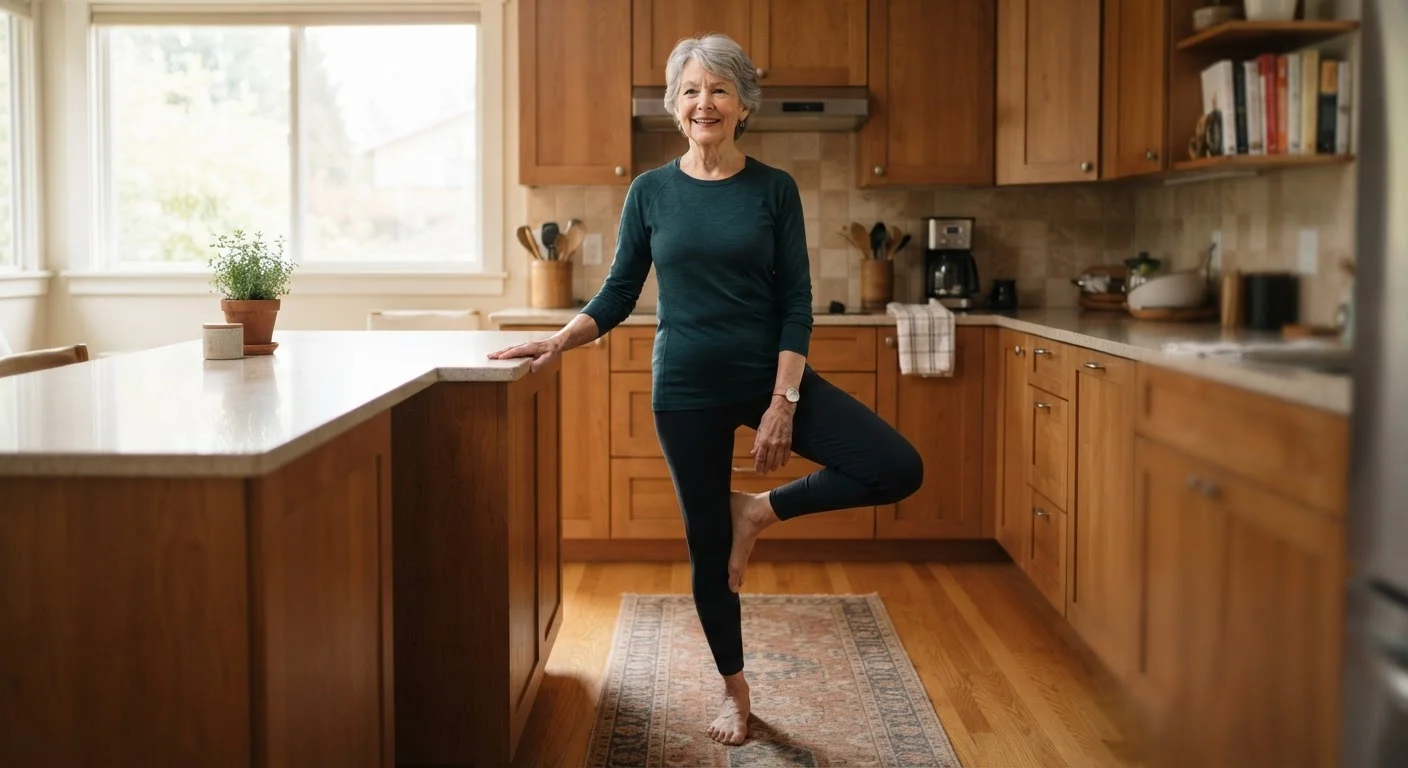
- Performing early exercises near a wall, sturdy chair, or countertop.
- Never practicing alone initially if you have significant instability.
- Wearing supportive, well-fitted footwear — avoid socks on bare floors.
- Ensuring the exercise area is clear of rugs, cords, and other tripping hazards.
Making your home environment safer overall reinforces training gains. Our guide to building a safe home environment covers practical modifications that complement an exercise routine.
Core Balance Exercises for Beginners
The following exercises are commonly recommended for older adults beginning balance training. They require no equipment beyond a sturdy support surface. Perform each exercise slowly and deliberately, focusing on controlled movement.
1. Weight Shifts
Stand with feet hip-width apart, hands resting lightly on a counter. Slowly shift your weight to one foot, hold for 5–10 seconds, then shift to the other. This trains the basic mechanics of single-leg stability.
2. Heel-to-Toe Walk (Tandem Walk)
Walk in a straight line, placing the heel of one foot directly in front of the toes of the other with each step. Use a wall beside you for light support as needed. This challenges dynamic balance and gait control.
3. Single-Leg Stand
Stand behind a chair, holding the back lightly. Lift one foot slightly off the ground and hold for up to 10 seconds. Switch sides. Progress by reducing contact with the chair as stability improves.
4. Sit-to-Stand
Rise from a chair without using your hands if safely possible. This builds the leg and core strength that underpins functional balance in everyday movement.
Progress at Your Own Pace
There is no universal timeline for balance improvement. Some people notice functional gains within a few weeks; others take longer depending on starting fitness level and any underlying health factors. Resist the urge to advance too quickly — stable mastery of easier exercises is more valuable than struggling through harder ones. Small, consistent steps produce lasting change.
Pairing balance exercises with resistance-based strength work accelerates progress, as stronger muscles provide the foundation that balance drills refine.
Building a Sustainable Routine
Consistency is the single most important variable in balance improvement. Brief, frequent practice outperforms occasional long sessions. A realistic starting point is two to three sessions per week, each 10–20 minutes in length, with rest days between.
As exercises become easier — you can hold positions steadily, complete sets without gripping support — introduce modest progressions: closing your eyes during a single-leg stand, standing on a folded towel to introduce mild surface instability, or reducing reliance on the support surface.
Track your progress informally. Note whether daily activities — rising from a chair, walking on uneven ground, navigating stairs — feel more confident over weeks. These functional gains are the true measure of success.
Balance training is most effective as part of a broader movement strategy. If you are also considering adding strength work, starting strength training after 40 provides a grounded introduction to progressing safely.
This article is for general informational and educational purposes only and does not constitute medical advice. Always consult a qualified healthcare professional before beginning a new exercise program, particularly if you have a history of falls, chronic conditions, or mobility concerns.
Frequently Asked Questions
Most clinical guidelines suggest practicing balance exercises at least two to three times per week. Even brief daily sessions of 10–15 minutes can produce measurable improvements over time. Consistency matters more than session length.
Balance training is often especially recommended for individuals with a fall history, but the program should be tailored to the person's current ability and health status. It is important to get clearance from a physician or physical therapist first, and to begin with supported, low-risk exercises.
Yes. Research consistently shows that balance can improve at any age with structured training. The nervous system retains significant adaptability well into later life, a property known as neuroplasticity.
No special equipment is required to begin. A sturdy chair or kitchen counter for support is sufficient for most beginner exercises. Equipment like foam pads or balance boards may be added later as stability improves.
Strength training builds muscle force, while balance training improves the body's ability to detect and correct shifts in its center of gravity. The two approaches complement each other — stronger leg and core muscles make balance easier to maintain.
You should consult a healthcare provider before beginning if you have had recent falls, feel unsteady on your feet, have a neurological or cardiovascular condition, or take medications that may affect balance or blood pressure. A physical therapist can also conduct a formal balance assessment.
The content on this site is for informational purposes only and is not a substitute for professional advice. Always consult a qualified professional for guidance specific to your situation.