
Our Verdict
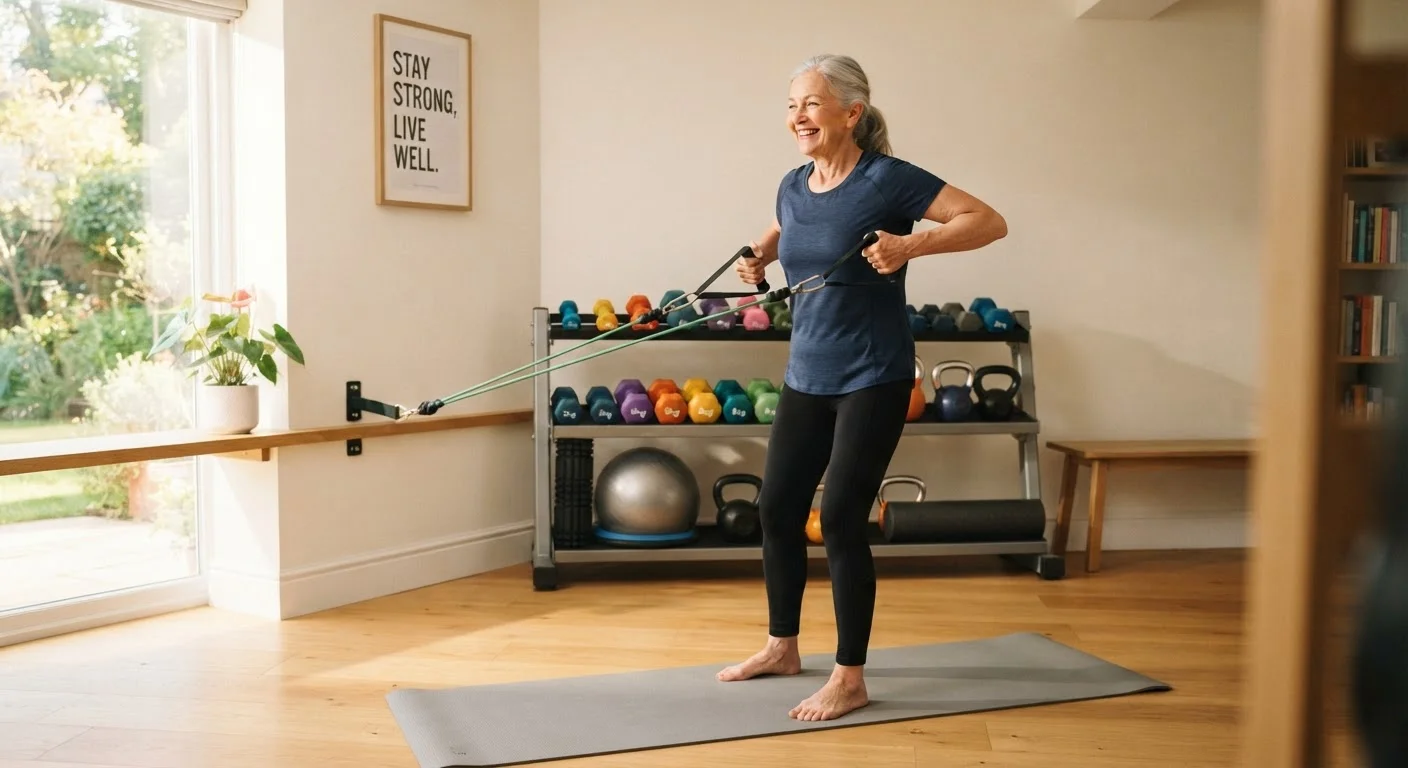
Neither free weights nor resistance bands is universally superior for older adults — each has meaningful advantages depending on the individual's health status, experience, and goals. Resistance bands tend to be more accessible and joint-friendly for beginners or those managing chronic conditions, while free weights offer more measurable progression for those with a strength baseline. Many evidence-based programs for seniors incorporate both.
| Best for | Recommended |
|---|---|
| Beginners or those with joint pain or balance concerns | Resistance Bands |
| Experienced exercisers seeking structured strength progression | Free Weights |
| Older adults with limited mobility or small living spaces | Resistance Bands |
| Those focused on long-term muscle mass preservation | Combined Approach |
Why Strength Training Matters More After 60
Adults naturally lose three to eight percent of their muscle mass per decade after age 30 — a process called sarcopenia — and this rate accelerates after 60. The consequences extend well beyond aesthetics: reduced muscle strength is directly linked to increased fall risk, loss of independence, and higher rates of chronic disease. The good news is that resistance exercise of any kind can counteract this decline at virtually any age.
The National Institute on Aging (NIA) recommends that older adults engage in muscle-strengthening activities at least two days per week. Both free weights and resistance bands meet that definition — but they accomplish the goal differently, and the distinction matters for safety and adherence. See our guide to balance training for older adults for a complementary approach to fall prevention.
How Free Weights and Resistance Bands Work Differently
Free weights — including dumbbells, barbells, and kettlebells — provide constant gravitational load. The resistance is fixed and predictable, making it straightforward to measure and progressively increase the challenge over time. This precision is valuable for building absolute strength and tracking gains systematically.
Resistance bands, by contrast, provide accommodating resistance: the tension increases as the band stretches further. This means the resistance is lighter at the start of a movement and heavier at full extension — a profile that tends to be gentler on joints at their most vulnerable positions. For exercises like squats or bicep curls, the peak load coincides with the strongest point in the movement arc, which many clinicians and physical therapists consider advantageous for older populations.
If you're newer to resistance exercise, our practical foundation for starting strength training after 40 covers core movement patterns and progression principles that apply to both tools.
| Free Weights | Resistance Bands | |
|---|---|---|
| Resistance type | Constant gravitational load | Accommodating (increases with stretch) |
| Load precision | Highly measurable and adjustable | Approximate; varies by band and stretch |
| Joint stress at vulnerable positions | Higher; load is constant throughout | Lower; lightest at weakest joint angle |
| Fall/injury risk | Moderate; requires balance and grip | Low; no dropped weight hazard |
| Portability and cost | Bulky; higher cost | Highly portable; low cost |
| Usability while seated | Limited | Excellent |
| Long-term progression | Straightforward with incremental weights | Possible but less precise |
Safety and Accessibility Considerations
For older adults managing osteoarthritis, osteoporosis, or balance difficulties, the risk profile of each method differs meaningfully. Free weights require greater stabilizer muscle engagement and postural control, which can elevate fall risk if used with poor technique or excessive loads. Dropping a dumbbell is a genuine hazard, particularly for those with reduced grip strength.
Resistance bands are portable, inexpensive, and usable while seated — making them accessible to adults with limited mobility or those exercising at home without specialized equipment. They also eliminate the risk of a dropped weight. However, bands do have limitations: they can snap if worn or improperly used, and resistance levels can be harder to quantify precisely.
Inspect Resistance Bands Before Every Use
Resistance bands degrade over time and can snap without warning if they develop cracks, fraying, or discoloration. Always inspect bands before each session and replace them at the first sign of wear. Never stretch a band beyond twice its resting length, and anchor it securely to prevent recoil injuries.
For a broader picture of low-impact options, our article on aquatic exercise for seniors explores another well-supported modality with its own trade-offs.
What the Evidence Says About Effectiveness
Research comparing the two approaches in older adult populations generally shows comparable gains in muscle strength and functional capacity when effort and progressive overload are matched. A systematic review published in the Journal of Human Kinetics found resistance band training produced significant improvements in strength, balance, and physical function in older adults — outcomes consistent with free-weight training studies at similar intensities.
The key variable is not the tool itself but progressive overload: the principle that muscles must be consistently challenged with increasing demands to continue adapting. Both methods support this when applied correctly — resistance bands come in graduated tensions, and free weights can be incrementally increased. Consistency and proper technique remain the dominant predictors of outcome regardless of equipment choice.
3–8%
Muscle mass lost per decade after age 30
According to research cited by the American College of Sports Medicine, this rate accelerates significantly after age 60.
2x/week
Recommended muscle-strengthening frequency for older adults
The National Institute on Aging recommends at least two days of muscle-strengthening activity per week for adults 65 and older.
For guidance on balancing strength work with cardiovascular exercise, see how to find the right balance between strength training and cardio.
Start with a Professional Assessment
Before choosing between free weights and resistance bands, consider a consultation with a physical therapist or certified trainer experienced in senior fitness. They can assess your current strength, joint health, and balance to recommend appropriate starting loads and exercises. A personalized baseline assessment also helps establish safe progression benchmarks and reduces the risk of overuse injury.
This article is for general informational and educational purposes only and is not a substitute for professional medical advice. Older adults, particularly those with existing health conditions, should consult a qualified healthcare provider or certified fitness professional before beginning or changing any exercise program.
The content on this site is for informational purposes only and is not a substitute for professional advice. Always consult a qualified professional for guidance specific to your situation.