
Our Verdict
Aquatic exercise is a clinically supported, low-impact option that offers meaningful benefits for joint health, cardiovascular fitness, and mobility in older adults. However, it is not a complete solution on its own — particularly for bone density maintenance — and practical barriers such as pool access and water safety remain real considerations. Used as part of a balanced activity plan, it is one of the most valuable tools available for active aging.
Older adults managing arthritis, joint replacement recovery, or chronic pain who want a consistent, evidence-backed exercise routine that is gentle on the body.
Why Water Exercise Appeals to Older Adults
Aquatic exercise — which includes water aerobics, lap swimming, water walking, and structured hydrotherapy — has become one of the most widely recommended forms of physical activity for older adults. The appeal is straightforward: water supports body weight through buoyancy, dramatically reducing the mechanical load on joints, spine, and connective tissue compared with land-based movement.
For seniors managing osteoarthritis, joint replacements, or chronic musculoskeletal pain, that reduction in impact can mean the difference between exercising consistently and not exercising at all. Research published in peer-reviewed rheumatology and gerontology journals consistently finds that aquatic programs improve pain scores, functional mobility, and self-reported quality of life in older populations. As you explore how exercise needs evolve over time, movement strategies shift meaningfully with age, and aquatic activity fits well into the later decades of an active life.
Buoyancy dramatically reduces joint load during movement
Water supports up to 90% of body weight when submerged to shoulder depth, allowing seniors with arthritis, joint replacements, or chronic pain to move with significantly less discomfort than on land.
Supports cardiovascular fitness and endurance
Water aerobics and lap swimming elevate heart rate and improve aerobic capacity, meeting guidelines for moderate-intensity exercise without the impact stresses of walking or jogging.
Water resistance builds muscle strength and endurance
Moving through water provides natural resistance in all directions, engaging muscle groups throughout the body without the need for weights or equipment.
Reduces fall-related injury risk during exercise
The aquatic environment cushions stumbles and missteps, making it a safer setting for seniors who are working on balance and coordination but are at elevated fall risk on land.
May improve mood and reduce pain perception
Warm-water immersion has been associated with reduced muscle tension and improved psychological well-being in older adults, which can support longer-term exercise adherence.
Group classes offer social engagement
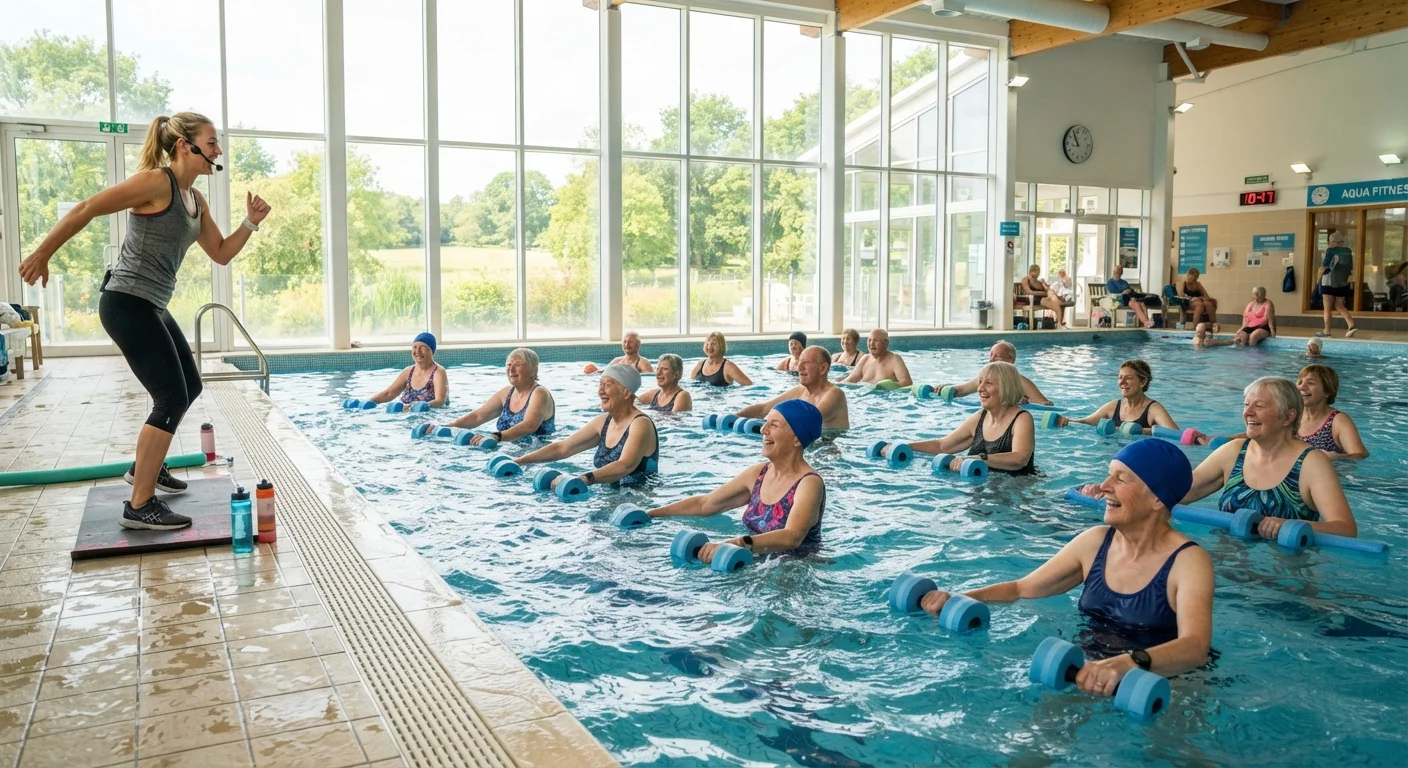
Community aquatic programs frequently involve group instruction, which provides social interaction that benefits mental health and helps older adults maintain consistent exercise habits.
The Limitations Worth Understanding
Despite its genuine advantages, aquatic exercise has several clinically important limitations that are sometimes overlooked in popular coverage of the topic.
Bone density: The most significant limitation is that water exercise is not weight-bearing. Bone remodeling requires mechanical loading — the kind that occurs when your skeleton bears your body weight against gravity. Aquatic exercise alone does not meaningfully stimulate bone density, making it insufficient as a stand-alone strategy for preventing or managing osteoporosis. Seniors at risk for bone loss are generally advised to incorporate some land-based weight-bearing activity as well. Resistance-based training on land remains an important complement for this reason.
Access and cost: Reliable access to a temperature-appropriate pool is not universally available. Many older adults, particularly those in rural areas or on fixed incomes, may find that pools are geographically distant, expensive to use consistently, or inconveniently scheduled. Transportation dependency adds another layer of difficulty.
Water safety: Not all seniors are confident swimmers, and pool environments carry fall risks — particularly around wet deck areas. Programs designed for non-swimmers do exist, but participants should always check that a certified lifeguard is on duty and that facilities have appropriate accessibility features such as pool lifts or gradual entry steps.
Does not stimulate bone density — a critical gap
Because water removes gravitational loading, aquatic exercise does not provide the mechanical stimulus bones need to maintain or increase density, limiting its usefulness as a standalone strategy for osteoporosis management.
Access, cost, and transportation are common barriers
Suitable heated pools are not universally available, and membership or session fees can be prohibitive for seniors on fixed incomes. Transportation to a facility adds further complexity for those without personal vehicles.
Water safety risks require appropriate facility standards
Wet pool decks, pool entry and exit points, and variable water depth create fall hazards. Facilities without lifeguard supervision, accessibility ramps, or pool lifts may not be suitable for all seniors.
Balance gains may not fully transfer to dry land
Improved stability in water does not automatically translate to equivalent land-based balance improvements, meaning aquatic exercise alone may not adequately address fall prevention in everyday environments.
Certain health conditions require medical clearance
Open skin wounds, some cardiovascular conditions, active infections, and incontinence issues may contraindicate pool use or require specific precautions before participation can safely begin.
Certain health conditions also warrant caution. Seniors with open wounds, urinary incontinence not managed by appropriate products, or specific cardiac or respiratory conditions should discuss participation with their physician before starting a pool-based program.
What the Evidence Actually Supports
The research base for aquatic exercise in older adults is generally positive but not without nuance. Studies consistently support improvements in lower-limb strength, aerobic endurance, balance, and pain management — particularly for individuals with osteoarthritis of the knee or hip. A Cochrane review of aquatic exercise for knee and hip osteoarthritis found short-term improvements in pain and physical function, though the magnitude of benefit was described as moderate rather than large.
Moderate
Evidence grade for pain and function in osteoarthritis
A Cochrane systematic review of aquatic exercise for knee and hip osteoarthritis found consistent but moderate-sized improvements in pain and physical function across included trials.
90%
Body weight supported in shoulder-depth water
When submerged to shoulder level, water buoyancy offsets approximately 90% of a person's body weight, according to widely cited rehabilitation medicine references.
Balance training in water has also attracted research interest given its relevance to fall prevention. The resistive properties of water allow seniors to practice dynamic balance challenges with a reduced consequence of falling — the water itself provides a buffer. However, improved water balance does not automatically transfer to dry-land stability, so land-based balance and strength work remains important. Common misconceptions about exercise and aging can deter seniors from pursuing the complementary land activity they need alongside aquatic programs.
If pool access is not feasible, other low-impact exercise options such as cycling, elliptical training, or tai chi can provide overlapping benefits without requiring a pool. And for seniors whose mobility is substantially limited, chair-based exercise programs offer a valuable alternative or complement.
Finding a Senior-Appropriate Aquatic Program
Many community recreation centers, YMCAs, and hospital-affiliated wellness programs offer aquatic exercise classes specifically designed for older adults or those with limited mobility. Look for classes led by instructors certified in aquatic fitness or therapeutic exercise, and confirm that the pool is heated to a comfortable temperature (typically 83–88°F for therapeutic use). Ask whether pool lifts or zero-entry access are available if getting in and out of the pool is a concern.
This article is for general informational purposes only and does not constitute medical advice. Older adults with existing health conditions, recent surgeries, or physical limitations should consult their healthcare provider before beginning or changing an exercise program.
The content on this site is for informational purposes only and is not a substitute for professional advice. Always consult a qualified professional for guidance specific to your situation.