
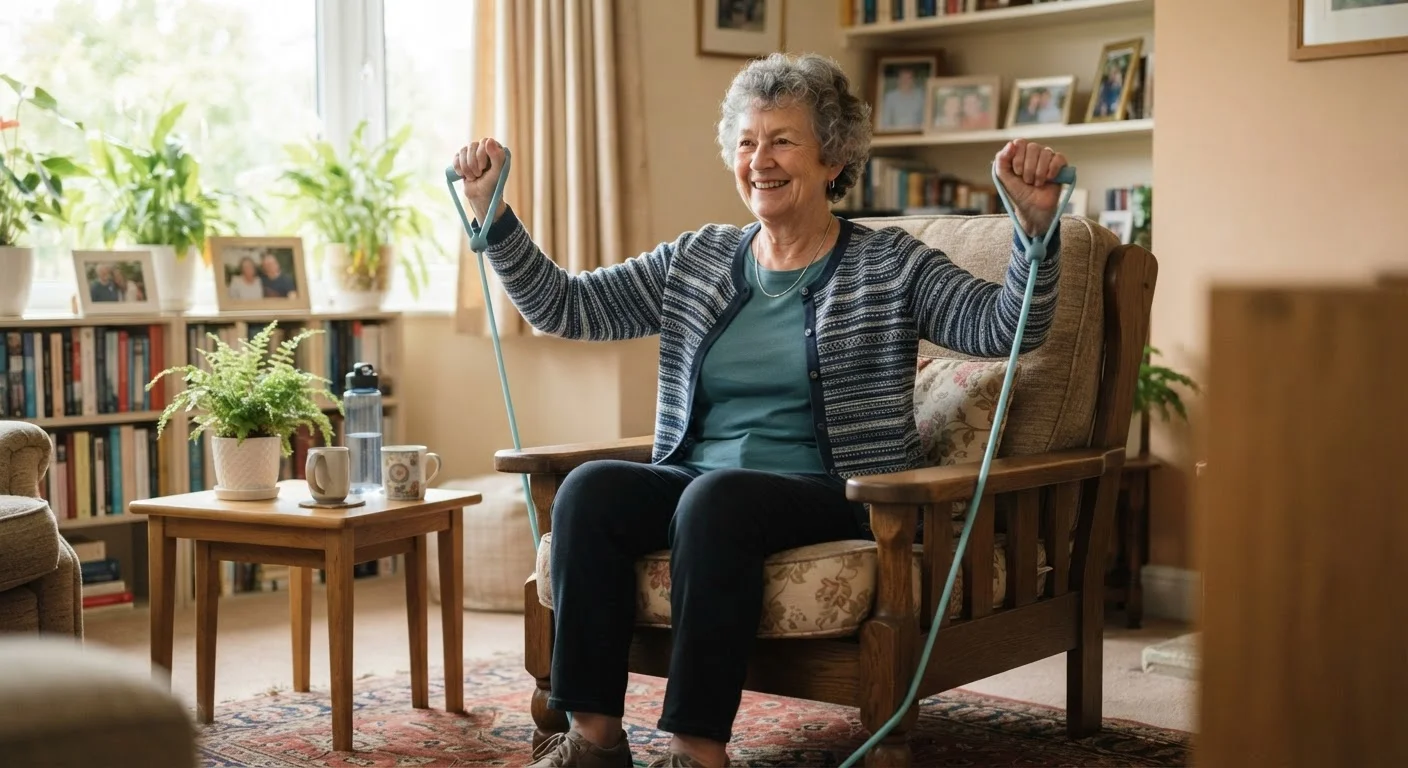
Why Seated Exercise Is a Clinically Recognized Option
Limited standing tolerance — whether due to balance impairment, joint pain, post-surgical recovery, or chronic conditions such as heart failure or peripheral artery disease — is one of the most common barriers older adults cite when it comes to physical activity. Yet the clinical evidence is clear: meaningful exercise does not require standing or walking.
Chair-based exercise programs have been studied extensively in older adult populations. Research published in gerontology and rehabilitation medicine journals demonstrates that seated resistance and aerobic movements can improve muscle strength, joint mobility, and cardiovascular markers in adults who cannot safely perform weight-bearing exercise. The National Institute on Aging (NIA) explicitly includes chair exercises in its physical activity guidance for older adults with mobility limitations.
It is worth addressing a persistent misconception directly: being sedentary is not a neutral state. Prolonged sitting without deliberate movement carries its own health risks, including reduced circulation, accelerated muscle atrophy, and increased fall risk over time. The habits that quietly undermine mobility are often subtle — and seated exercise is one of the most accessible ways to counteract them. For a broader look at what the evidence says about sedentary time, see the science behind sedentary behaviour.
If you have previously assumed that exercise is off the table because of physical limitations, common myths about exercise and aging may be worth revisiting — the evidence often contradicts those assumptions.
What You'll Need and How to Get Started
What you will need
Sturdy armless chair
Provides a stable base for all seated exercises; armrests can interfere with arm movements.
Resistance band
Adds progressive resistance to upper- and lower-body exercises without requiring weights.
Light hand weights or water bottles
Used to add load to arm curl and shoulder press movements as strength improves.
Non-slip mat
Placed under the chair to prevent sliding on smooth floors during movement.
Set up your chair and space safely
Place a sturdy, non-wheeled chair on a flat, non-slip surface with at least an arm's length of clear space on each side. Sit toward the front half of the seat so your feet rest flat on the floor with knees at roughly a 90-degree angle. Sit tall with your back away from the chair back to encourage postural engagement throughout the session.
Begin with a gentle seated warm-up
Spend 3–5 minutes warming up to prepare joints and increase circulation before any strengthening work. Start with seated marching: lift alternate knees slowly toward the ceiling for 20 repetitions. Follow with ankle circles — rotate each ankle 5 times clockwise and counterclockwise. Finish with gentle shoulder rolls, 5 forward and 5 backward.
Perform seated lower-body strengthening
Work the major leg muscle groups with these two foundational movements:
- Seated leg extensions: Straighten one knee fully, hold for 2 seconds, then lower slowly. Complete 10–12 repetitions per leg. This targets the quadriceps — key muscles for standing stability.
- Heel raises: While seated, raise both heels off the floor as high as comfortable, hold briefly, then lower. Repeat 10–15 times to engage the calf muscles and support ankle circulation.
Rest for 30–60 seconds between exercises as needed.
Add seated upper-body strengthening
Upper-body exercises preserve the functional strength needed for daily tasks such as lifting, reaching, and carrying. Try these movements:
- Bicep curls: Hold light weights or water bottles at your sides, curl toward your shoulders, then lower slowly. Complete 10–12 repetitions.
- Overhead press: With hands at shoulder height, press upward until arms are extended (not locked), then lower. Repeat 8–10 times.
- Seated rows with resistance band: Loop a resistance band around a fixed point in front of you, grip the ends, and pull elbows back in a rowing motion. Complete 10 repetitions.
Include a seated flexibility and balance segment
Flexibility work reduces stiffness and supports range of motion; seated balance challenges build the neuromuscular control that protects against falls. Try these:
- Seated hamstring stretch: Extend one leg in front, flex the foot, and hinge gently forward at the hips until you feel a mild pull in the back of the thigh. Hold 20–30 seconds per side.
- Seated torso rotation: Cross your arms over your chest and rotate slowly to each side, holding briefly at the end range. Repeat 5 times per side.
- Single-leg stand (supported): Holding the seat edges, lift one foot just off the floor for 5–10 seconds. This challenges balance in a controlled, lower-risk position.
Cool down and reflect on how you feel
End each session with 2–3 minutes of slow, deep breathing combined with gentle neck and shoulder stretches. Take note of any unusual discomfort, dizziness, or shortness of breath — these symptoms should be reported to your healthcare provider. Over days and weeks, brief notes about how each session felt can help you and your care team track progress and adjust intensity appropriately.
Making It a Sustainable Habit
Build Gradually for Lasting Results
Begin with one set of each exercise and progress to two or three sets over several weeks as your strength and endurance increase. Research in exercise gerontology consistently shows that gradual progressive overload — even at low intensities — produces meaningful improvements in muscle function for older adults. Avoid the common mistake of doing too much too soon, which raises injury risk and can discourage continuation.
Aim for at least 150 minutes of moderate-intensity physical activity per week — a target consistent with guidelines from the CDC and the American College of Sports Medicine, adapted for individual capacity. For someone using a seated program, this might look like five 20–30 minute sessions spread across the week, though shorter more frequent sessions are equally valid.
Seated exercise is one component of a broader activity strategy. When mobility allows, complementary approaches such as low-impact exercise or, where accessible, aquatic exercise can add variety and different physiological benefits. The key is finding a sustainable combination that fits your health status, environment, and preferences.
Consider working with a physical therapist or certified senior fitness specialist to develop a program calibrated to your needs. Many community centers, hospitals, and telehealth platforms offer chair exercise classes specifically designed for older adults, which can also provide the social engagement that supports long-term adherence.
Know When to Stop and Seek Guidance
Discontinue any exercise immediately if you experience chest pain, severe shortness of breath, sudden dizziness, or significant joint pain. These are not normal responses to low-intensity seated activity. Report any such symptoms to a healthcare provider promptly. Do not attempt to exercise through pain — discomfort and pain are meaningfully different, and distinguishing them is important for safe progression.
Consult Your Provider Before Starting
Older adults managing heart disease, diabetes, osteoporosis, recent surgery, or other chronic conditions should obtain clearance from their physician or physical therapist before beginning any new exercise program — even a gentle seated one. A qualified professional can identify any contraindicated movements and help tailor a routine that is both safe and effective for your specific health profile.
This article is for general informational and educational purposes only and does not constitute medical advice. Always consult a qualified healthcare professional before beginning any new exercise program, particularly if you have existing health conditions or mobility limitations.
The content on this site is for informational purposes only and is not a substitute for professional advice. Always consult a qualified professional for guidance specific to your situation.