

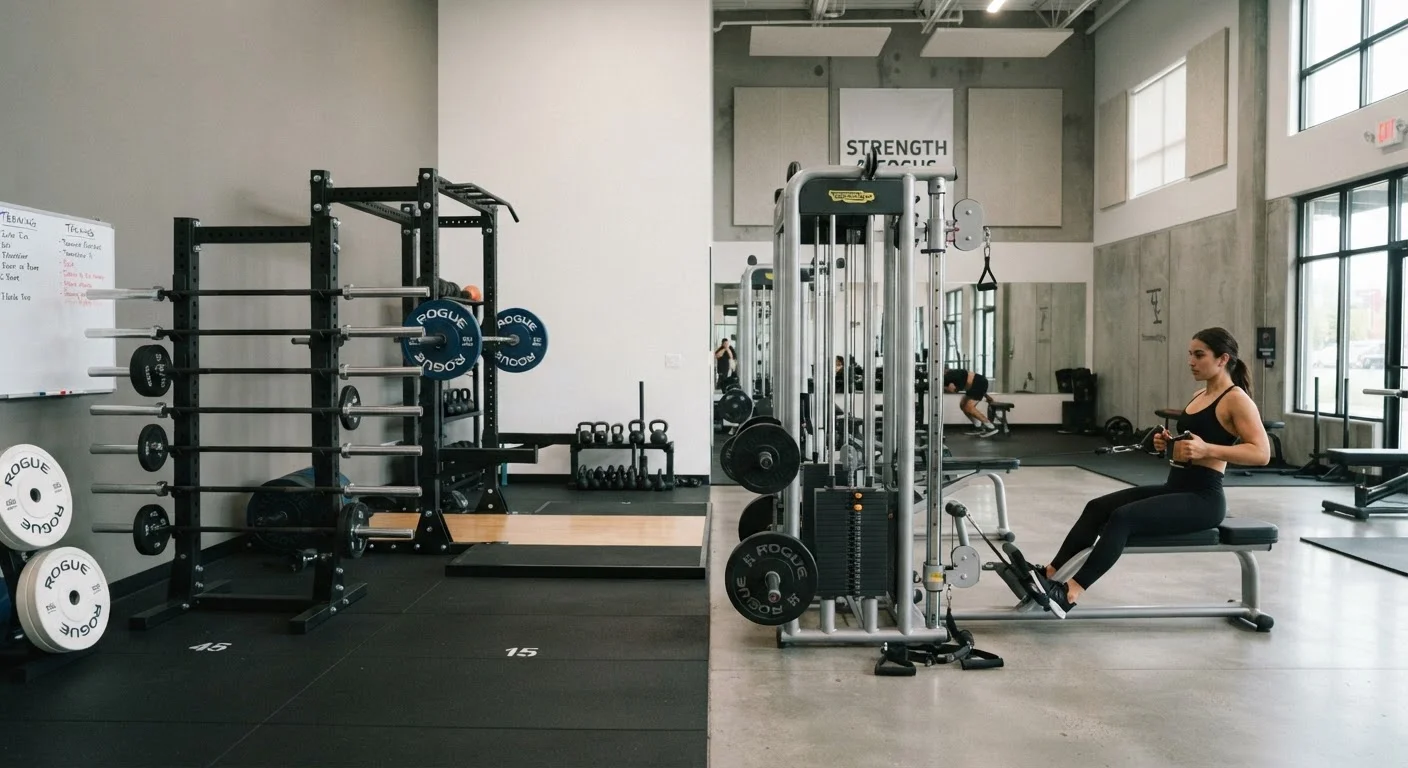
Option A
Free Weights
The multi-joint, stabilizer-demanding classic.
Best for: Building functional strength, coordination, and muscle across multiple movement patterns simultaneously.
Option B
Resistance Machines
The guided, targeted isolation specialist.
Best for: Isolating specific muscles, training safely around injuries, and learning movement patterns with less coordination demand.
The Core Mechanical Difference
The most fundamental distinction between free weights and machines isn't about difficulty or effectiveness — it's about how the load is stabilized. When you press a barbell overhead, your body must control the bar's path through three-dimensional space. Every small deviation is corrected in real time by dozens of smaller stabilizing muscles. A shoulder press machine eliminates that variable by constraining the movement to a fixed arc.
This isn't a flaw in either tool — it's a feature of both. Free weights train the nervous system alongside the muscles. Machines let you isolate one muscle and load it without the surrounding system having to keep up. Understanding that distinction is what makes you a smarter programmer.
Compound movements like squats, deadlifts, and rows lean heavily into the free-weight advantage, training multiple joints and muscle groups in coordinated patterns. Machines, by contrast, excel at single-joint isolation work — leg curls, chest flyes, cable tricep pushdowns.
| Criterion | Free Weights | Resistance Machines |
|---|---|---|
| Stabilizer muscle recruitment | High — body controls path | Low — machine controls path |
| Isolation of target muscle | Moderate | High |
| Technical skill required | High | Low to moderate |
| Beginner accessibility | Lower | Higher |
| Functional movement transfer | Strong | Limited |
| Injury rehabilitation utility | Limited (depends on injury) | Often preferred |
| Equipment space / portability | Compact (dumbbells, barbells) | Large footprint, gym-dependent |
| Progressive overload ease | Flexible, fine-grained | Fixed weight increments |
What the Research Says About Muscle Activation
Electromyography (EMG) studies — which measure electrical activity in muscle tissue — generally show that free-weight exercises produce higher total muscle activation across the body than their machine equivalents. A 2019 study published in the Journal of Human Kinetics found that free-weight squats activated the biceps femoris and erector spinae significantly more than a leg press machine performing a similar movement pattern.
That said, machines can match or exceed free weights for the primary target muscle when the stabilizer demand is removed. A seated chest press machine may produce comparable pec activation to a barbell bench press, while sparing the shoulder stabilizers entirely — which can be an advantage when those stabilizers are fatigued or injured.
43%
Greater stabilizer activation with free weights
A peer-reviewed EMG analysis found free-weight squats activated stabilizing muscles roughly 43% more than a matched leg press exercise.
~30%
Injury risk tied to technique errors
Research in sports medicine consistently identifies improper technique and excessive load progression — not equipment type — as the primary drivers of resistance training injuries.
The practical takeaway: free weights train more muscle with every set, but machines let you load a specific muscle harder without systemic fatigue limiting the effort. Both outcomes have legitimate places in a training program.
Learning Curve, Safety, and Injury Risk
Free weights demand technical skill. A barbell back squat requires adequate hip mobility, thoracic extension, core bracing, and bar position awareness — all before a single rep is completed. When technique breaks down under fatigue, injury risk rises. This is not a reason to avoid free weights, but it is a reason to respect the learning curve and consider working with a qualified coach when starting out.
Machines are significantly more forgiving for beginners and for those training alone without a spotter. The fixed movement path reduces the margin for form error. For older adults in particular — especially those managing joint conditions — machines can offer a lower barrier to consistent training. See how these trade-offs play out in the context of aging in our article on strength training for older adults.
A Note on Training Around Injuries
If you are managing an existing injury or chronic joint condition, the decision between free weights and machines should involve a physical therapist or sports medicine physician — not just personal preference. Machines are frequently used in clinical rehabilitation settings precisely because they allow controlled loading of a muscle while protecting surrounding structures. What works for a healthy lifter may not apply to your situation.
Neither tool is inherently dangerous. Injury risk in resistance training is most closely associated with load mismanagement and poor technique — not the equipment itself.
Building a Program That Uses Both
The most evidence-supported approach for most men is a hybrid program that uses free weights for primary compound lifts and machines for accessory or isolation work. A typical session might open with a barbell squat or deadlift — movements that train the whole system — and finish with machine leg extensions or a cable row to add volume to a specific muscle without stacking additional technical demand onto a fatigued body.
This structure also maps well onto goal-setting. If your primary aim is functional core strength vs. aesthetic development, the proportion of free-weight to machine work may shift accordingly. Functional strength goals favor free weights; hypertrophy-focused programs benefit from machine volume.
If you're unsure how to balance lifting with other forms of exercise, the broader context of strength training and cardio is worth reviewing. There's no single correct ratio — but deliberate programming always beats defaulting to whichever equipment is available.
This article is for general informational purposes only and does not constitute medical or personal training advice. Consult a qualified healthcare professional or certified trainer before beginning or modifying any exercise program, especially if you have an existing injury or health condition.
The content on this site is for informational purposes only and is not a substitute for professional advice. Always consult a qualified professional for guidance specific to your situation.