

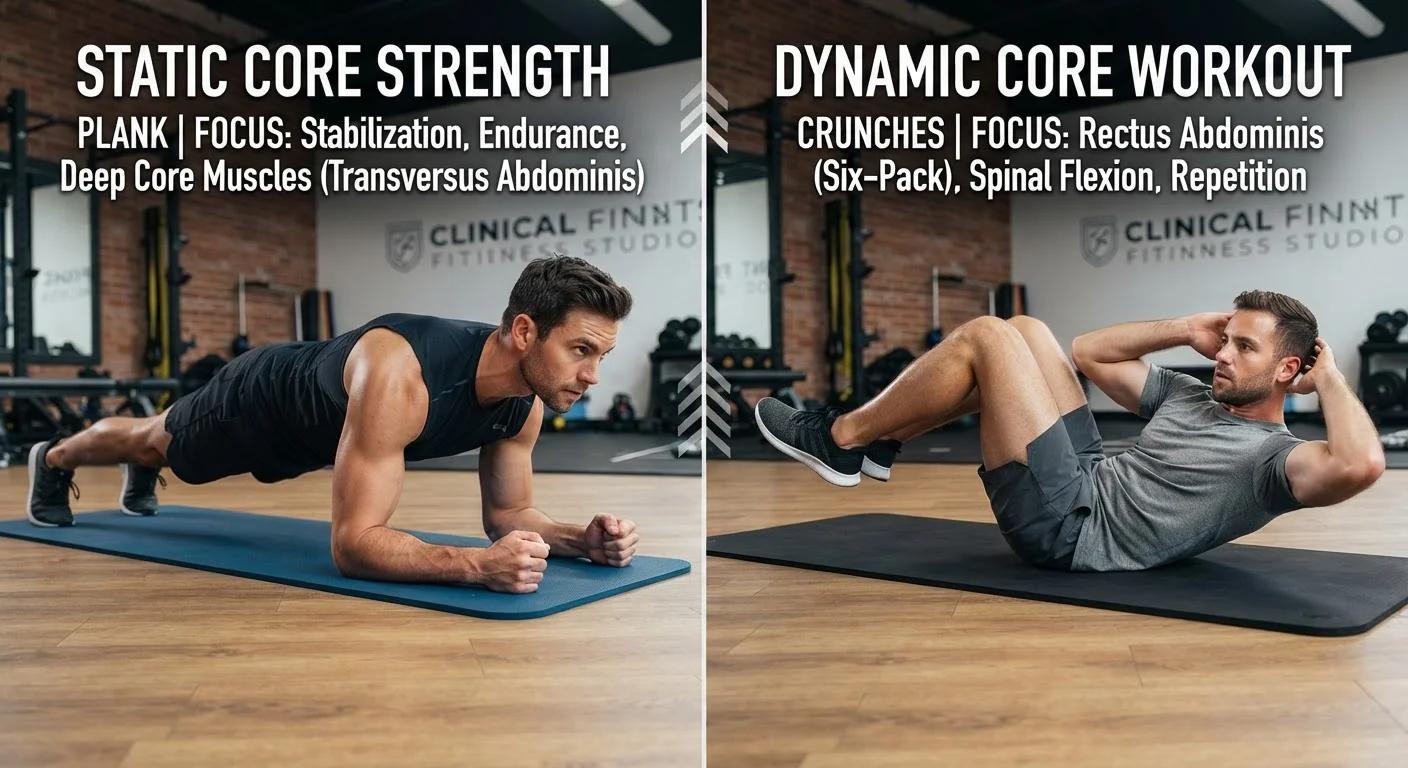
Option A
Core Strength Training
The functional, performance-driven approach.
Best for: Men who want better posture, injury resilience, athletic performance, and transferable strength across daily movement and sport.
Option B
Aesthetic Abs Training
The physique-focused, visibility-driven approach.
Best for: Men whose primary goal is visible abdominal definition, typically for bodybuilding, physique competitions, or personal appearance goals.
Two Goals, Two Different Definitions of Success
When most men talk about wanting a stronger core, they mean one of two very different things: the ability to brace, stabilize, and transfer force effectively — or the ability to see their abs in the mirror. These outcomes aren't mutually exclusive, but they are driven by different mechanisms and respond to different training stimuli.
Core strength refers to the coordinated function of deep and superficial muscles — including the transverse abdominis, multifidus, obliques, and diaphragm — that control spinal position under load. Aesthetic abs, on the other hand, are primarily a function of subcutaneous body fat levels over the rectus abdominis. Understanding that distinction changes everything about how you train. See our guide to compound movements for context on why core stability underpins almost every major lift.
| Criterion | Core Strength Training | Aesthetic Abs Training |
|---|---|---|
| Primary goal | Functional stability and force control | Visible abdominal muscle definition |
| Key driver | Neuromuscular coordination and load tolerance | Low body fat percentage over the abs |
| Exercise emphasis | Anti-movement, bracing, loaded carries | Isolation moves, high-rep flexion, volume |
| Role of diet | Supports performance and recovery | Central — caloric deficit is non-negotiable |
| Muscles targeted | Deep stabilizers + superficial abs | Rectus abdominis and obliques primarily |
| Transferable benefit | Injury resilience, athletic performance | Muscular size and visual symmetry |
| Timeline to results | Strength gains within weeks of consistent training | Visibility depends on fat loss — highly variable |
How Functional Core Training Actually Works
Functional core training prioritizes anti-movement — anti-rotation, anti-extension, and anti-lateral-flexion — over repeated spinal flexion. Exercises like dead bugs, pallof presses, loaded carries, and RKC planks challenge the core to resist force rather than produce it through crunching motions. This is closer to how the core functions in real life and sport.
Research consistently supports the role of deep stabilizer co-activation in protecting the lumbar spine and improving force transmission through the kinetic chain. Athletes, desk workers, and older adults alike benefit from this type of training. It also complements the stability training pillar that most fitness programs undervalue.
~10–12%
Body fat threshold for visible abs in most men
Exercise physiologists generally cite sub-12% body fat as the range where abdominal definition becomes visible for most men, though individual variation is significant.
0%
Evidence supporting spot reduction of abdominal fat
Multiple controlled studies, including a widely cited 2011 trial in the Journal of Strength and Conditioning Research, found no significant localized fat loss from targeted ab exercise.
29 muscles
Muscles involved in core stabilization
Research from the National Strength and Conditioning Association identifies approximately 29 muscles contributing to trunk and core stability, far beyond the visible rectus abdominis.
The Real Drivers of Visible Abs
Ab visibility is overwhelmingly determined by body fat percentage, not by the number of crunches performed. The rectus abdominis — the 'six-pack' muscle — is present in every anatomically typical adult male. What obscures it is subcutaneous fat overlying the muscle. No exercise protocol selectively removes fat from the abdominal region; that concept, often called 'spot reduction,' is not supported by evidence.
To achieve visible abs, a sustained caloric deficit that reduces overall body fat is necessary. The specific body fat threshold for ab visibility varies between individuals due to genetics, fat distribution patterns, and muscle mass. High-rep ab exercises can increase muscular size and definition, but that definition only becomes visible once fat levels are sufficiently low. For men structuring a training plan that addresses both nutrition timing and exercise, our weekly training plan guide offers practical frameworks.
Where the Two Approaches Overlap — and Where They Diverge
Both goals share some common ground. Exercises like hanging leg raises, ab wheel rollouts, and cable crunches build both muscular size and anti-extension strength. Heavy compound lifts — squats, deadlifts, overhead presses — demand high levels of core bracing and contribute meaningfully to functional strength while also stimulating abdominal muscle growth.
The divergence lies in programming emphasis. Functional core training distributes stimulus across stabilizer muscles throughout every session, embedded in compound movement patterns. Aesthetic ab training front-loads direct isolation work, often with higher rep ranges and progressive overload targeted at the rectus abdominis and obliques, while placing equal or greater weight on nutritional strategy.
Men who want both outcomes — stability and visible definition — need to sequence their priorities honestly. Core function is harder to fake and more foundational; it supports the balance between strength and cardio that long-term health requires. Aesthetic results depend heavily on factors outside the gym, particularly diet consistency over time.
Core Training for Older Adults
Functional core stability becomes especially important with age, as declining muscle coordination contributes to fall risk and back pain. Low-impact options like dead bugs, supine leg lowering, and seated stability exercises can be adapted for older or less mobile individuals. For a detailed look at strength training considerations in this population, see our comparison of strength training and resistance bands for older adults. Always consult a healthcare provider before starting a new program if you have existing health conditions.
This article provides general fitness education and is not a substitute for personalized guidance from a qualified fitness professional or healthcare provider. If you have a history of back pain or spinal injury, consult a clinician before beginning any new core training program.
The content on this site is for informational purposes only and is not a substitute for professional advice. Always consult a qualified professional for guidance specific to your situation.