

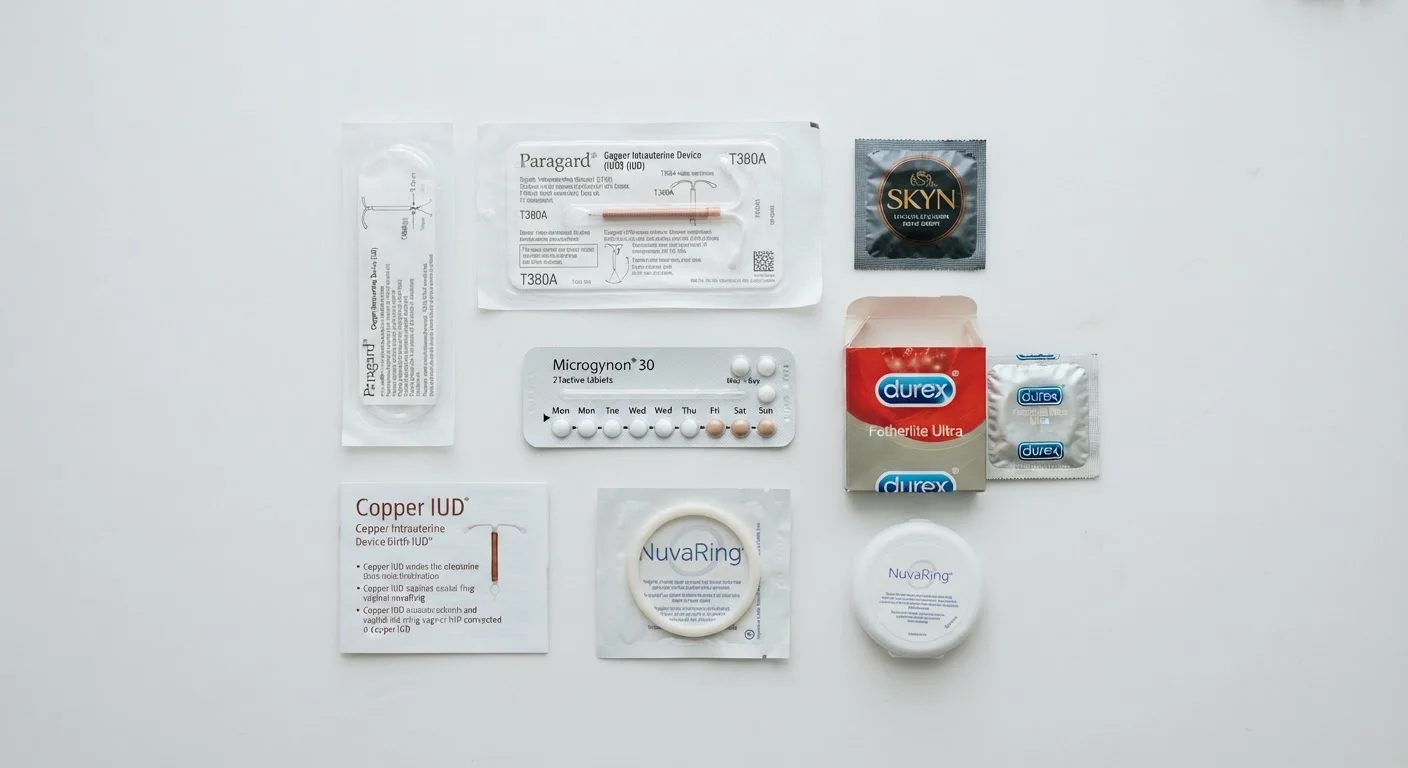
Option A
Hormonal Contraception
The widely used, multi-mechanism approach.
Best for: Women seeking highly effective pregnancy prevention who may also benefit from regulated cycles, reduced cramping, or management of conditions like endometriosis.
Option B
Non-Hormonal Contraception
The hormone-free alternative with diverse options.
Best for: Women who cannot use hormones for medical reasons, prefer to avoid synthetic hormones, or want contraception that doesn't alter their natural hormonal cycle.
How Hormonal Contraception Works
Hormonal contraceptives use synthetic versions of estrogen, progestin, or both to prevent pregnancy through several overlapping mechanisms. Combined estrogen-progestin methods — such as oral contraceptive pills, the patch, and the vaginal ring — primarily suppress ovulation by disrupting the hormonal signals that trigger egg release. Progestin-only methods, including the mini-pill, hormonal IUD, implant, and injectable, work mainly by thickening cervical mucus to block sperm and, in some cases, inhibiting ovulation.
The hormonal IUD (levonorgestrel-releasing) is particularly notable: it acts largely locally within the uterus, resulting in lower systemic hormone levels than pill-based methods. The subdermal implant, a small rod inserted under the skin of the upper arm, releases etonogestrel continuously and is among the most effective methods available, with a failure rate of less than 0.1% with perfect use.
For a broader look at how hormonal contraception affects health beyond pregnancy prevention, see our in-depth review of its benefits and drawbacks.
| Criterion | Hormonal Contraception | Non-Hormonal Contraception |
|---|---|---|
| Primary mechanism | Suppresses ovulation, thickens mucus | Physical or chemical barrier to sperm |
| Highest efficacy option | Implant (<0.1% failure rate) | Copper IUD (<1% failure rate) |
| STI protection | None | Condoms only |
| Affects natural hormone cycle | Yes | No |
| Immediate fertility return | Varies by method | Typically immediate |
| Non-contraceptive health benefits | Possible (cycle regulation, pain reduction) | Generally none beyond contraception |
| Systemic side effects | Possible (mood, libido, headache) | Minimal to none |
| Suitable during breastfeeding | Progestin-only methods generally yes; combined methods require caution | Yes for most methods |
How Non-Hormonal Contraception Works
Non-hormonal contraception encompasses a diverse range of methods that prevent pregnancy without altering the body's hormonal environment. The copper IUD — the most effective non-hormonal option available — works by releasing copper ions that are toxic to sperm, impairing their motility and fertilization capacity. It can remain effective for up to 10–12 years depending on the device, and also serves as emergency contraception when inserted within five days of unprotected sex.
Barrier methods — including male and female condoms, diaphragms, and cervical caps — physically prevent sperm from reaching the egg. Condoms are uniquely valuable because they also reduce transmission of many sexually transmitted infections (STIs); no hormonal method offers this protection. Fertility awareness-based methods (FABMs) involve tracking menstrual cycles, basal body temperature, and cervical mucus patterns to identify and avoid fertile days. When taught and practiced rigorously, some FABMs show reasonable effectiveness, but typical-use failure rates are considerably higher than for device-based methods.
99%+
Copper IUD perfect-use effectiveness
According to the CDC, the copper IUD has a failure rate of less than 1% with typical use, making it one of the most reliable non-hormonal methods.
~9%
Typical-use failure rate for oral contraceptive pills
The CDC reports that combined oral contraceptive pills have a typical-use failure rate of approximately 9%, compared to less than 1% with perfect use.
~24%
Typical-use failure rate for fertility awareness methods
The CDC estimates fertility awareness-based methods have a typical-use failure rate of roughly 2–24%, depending on the specific approach and training received.
For women navigating midlife contraceptive decisions alongside hormonal changes, our Hormones & Menopause hub provides helpful context.
Key Differences at a Glance
Choosing between hormonal and non-hormonal methods involves weighing effectiveness, side effect profiles, convenience, and individual health factors. The comparison above captures the most clinically relevant distinctions, but a few deserve deeper attention.
Efficacy data is typically reported as perfect-use versus typical-use failure rates. A method that is theoretically very effective may perform differently in real-world use. Long-acting methods — both hormonal and non-hormonal — close the gap between perfect and typical use because they remove the need for daily or per-encounter action. For a full breakdown of duration-based differences, compare long-acting and short-acting contraceptive options.
Side effect profiles differ markedly. Hormonal methods can affect mood, libido, breast tenderness, and cycle regularity — experiences that vary considerably between individuals and between specific formulations. Non-hormonal methods carry no systemic hormonal side effects, though the copper IUD may increase menstrual flow and cramping, particularly in the months after insertion.
Hormonal Contraception and Underlying Health Conditions
Certain health conditions — including a history of blood clots, estrogen-sensitive cancers, uncontrolled hypertension, or migraine with aura — may make combined hormonal contraceptives unsuitable. The World Health Organization's Medical Eligibility Criteria for Contraceptive Use provides a widely referenced framework that clinicians use to match methods to individual health profiles. Always disclose your full medical history to your healthcare provider when discussing contraceptive options.
This article is for informational purposes only and is not medical advice. Always consult a qualified healthcare provider before starting, stopping, or changing any contraceptive method.
The content on this site is for informational purposes only and is not a substitute for professional advice. Always consult a qualified professional for guidance specific to your situation.