

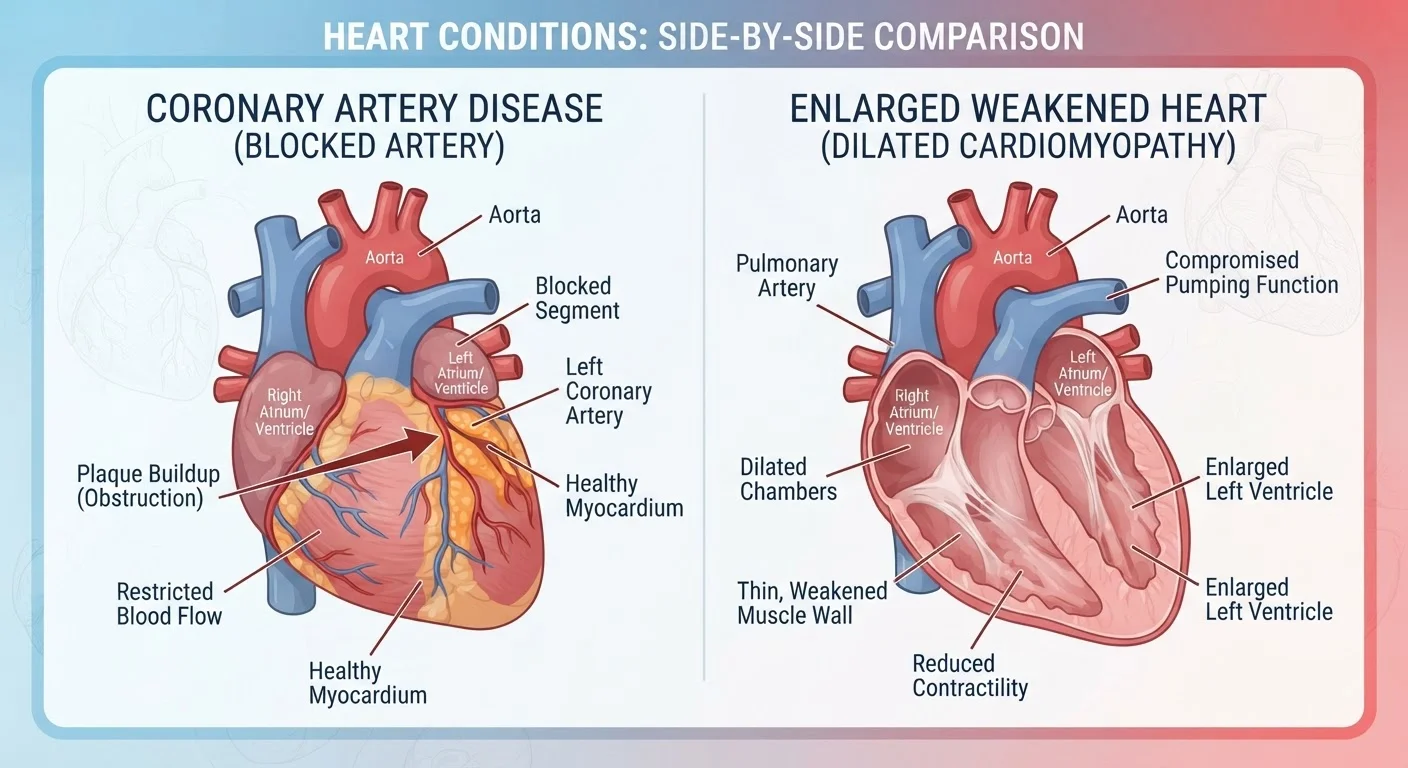
Option A
Heart Attack (Myocardial Infarction)
A sudden, acute emergency caused by a blocked blood supply.
Best for: Recognizing as a medical emergency requiring immediate 911 response and hospital intervention.
Option B
Heart Failure
A chronic, progressive condition where the heart pumps inefficiently.
Best for: Understanding as a long-term condition requiring ongoing management, lifestyle adjustment, and monitoring.
Two Different Problems, One Vital Organ
The terms "heart attack" and "heart failure" are often used interchangeably in everyday conversation, but clinically they describe fundamentally different events with different causes, timelines, and responses. Confusing them can delay appropriate action — a potentially life-threatening mistake for older adults, who face elevated risk for both.
A heart attack (medically, a myocardial infarction) is an acute event. A coronary artery — one of the vessels supplying oxygen-rich blood to the heart muscle — becomes suddenly blocked, typically by a ruptured plaque or a blood clot. Without blood flow, heart muscle begins to die within minutes. This is a medical emergency. For more context on how these conditions fit into the broader cardiovascular landscape, see our comprehensive cardiovascular disease overview.
Heart failure, by contrast, is a chronic syndrome. The heart muscle — weakened by prior damage, high blood pressure, or disease — loses its ability to pump blood efficiently. The body compensates for a time, but eventually fluid backs up into the lungs and limbs, causing the hallmark symptoms of breathlessness, fatigue, and swelling. It develops over months or years, not minutes.
| Criterion | Heart Attack | Heart Failure |
|---|---|---|
| Nature of condition | Acute, sudden emergency | Chronic, progressive syndrome |
| Primary cause | Blocked coronary artery | Weakened or stiff heart muscle |
| Onset of symptoms | Minutes to hours | Weeks to months |
| Key symptoms | Chest pain, arm/jaw pain, sweating | Breathlessness, leg swelling, fatigue |
| Immediate response | Call 911 — emergency intervention | Urgent physician evaluation |
| Long-term management | Rehabilitation, medication, lifestyle | Ongoing medication, monitoring, lifestyle |
| Can one cause the other? | Yes — can lead to heart failure | Does not directly cause heart attacks |
Symptoms: Where the Confusion Begins
Both conditions can cause chest discomfort, fatigue, and shortness of breath, which is precisely why they're so often conflated. However, the character and context of these symptoms differ in important ways.
Heart attack symptoms typically arise suddenly and may include:
- Intense pressure, squeezing, or pain in the chest, often radiating to the left arm, jaw, neck, or back
- Sudden shortness of breath
- Cold sweats, nausea, or light-headedness
- A sense of impending doom
Importantly, older adults and women are more likely to experience atypical presentations — such as unusual fatigue, indigestion-like discomfort, or back pain — without the classic crushing chest pain. Learn which subtle heart attack signals are most often overlooked so you know when to act immediately.
Heart failure symptoms, by contrast, tend to build gradually:
- Persistent shortness of breath, especially when lying flat (orthopnea)
- Swelling in the ankles, feet, or legs (edema)
- Rapid or unexplained weight gain from fluid retention
- Chronic fatigue and reduced exercise tolerance
- A persistent cough or wheezing, sometimes producing pink-tinged mucus
Atypical Symptoms Are More Common in Older Adults
Research consistently shows that older adults are more likely to present with non-classic heart attack symptoms — including unusual fatigue, nausea, or back pain — rather than the textbook crushing chest pain. This can lead to dangerous delays in seeking care. If something feels wrong with your heart, trust that instinct and seek medical attention without waiting for a "typical" symptom pattern to emerge.
Because symptoms can overlap and atypical presentations are common in older adults, any new or worsening cardiac symptoms should be evaluated by a healthcare provider promptly — and any suspicion of a heart attack warrants an immediate call to emergency services.
Causes, Risk Factors, and the Link Between the Two
Heart attacks are most commonly caused by coronary artery disease (CAD) — a buildup of fatty plaques (atherosclerosis) that narrows the arteries. When a plaque ruptures, a clot can form rapidly, blocking blood flow entirely. Key risk factors include hypertension, high cholesterol, diabetes, smoking, obesity, and a sedentary lifestyle. Cardiovascular risk shifts meaningfully with age — making awareness increasingly important from middle age onward.
Heart failure has multiple underlying causes. The most common include:
- Prior heart attack: Damaged heart muscle pumps less effectively, making a previous myocardial infarction one of the leading causes of heart failure.
- Hypertension: Chronically high blood pressure forces the heart to work harder, eventually weakening or stiffening the muscle.
- Cardiomyopathy: Disease of the heart muscle itself, which can be inherited or caused by infection, alcohol use, or chemotherapy.
- Valvular heart disease: Faulty heart valves force the heart to compensate with extra workload over time.
This causal relationship is crucial: surviving a heart attack does not mean the danger has passed. Long-term cardiac monitoring after a myocardial infarction is essential, partly because the risk of subsequently developing heart failure is substantial. Discussing this trajectory openly with a cardiologist is an important part of post-event care.
~50%
Heart failure cases linked to coronary artery disease
According to the American Heart Association, coronary artery disease — the same disease that causes most heart attacks — is implicated in roughly half of all heart failure cases.
6.7M
U.S. adults living with heart failure
The CDC estimates that approximately 6.7 million American adults aged 20 and older have heart failure, with prevalence rising steeply after age 65.
805,000
Heart attacks occur in the U.S. each year
The CDC reports that approximately 805,000 Americans experience a heart attack annually, with the majority occurring in adults over age 65.
Diagnosis and Long-Term Management
Diagnosing a heart attack involves emergency electrocardiography (ECG) to detect abnormal electrical patterns, blood tests measuring cardiac enzymes (such as troponin) released by damaged muscle, and imaging such as echocardiography or coronary angiography. Treatment in the acute phase focuses on restoring blood flow — through clot-dissolving medications, percutaneous coronary intervention (stenting), or bypass surgery — as quickly as possible.
Diagnosing heart failure involves echocardiography to measure ejection fraction (the percentage of blood the heart pumps out per beat), chest X-ray, blood tests including B-type natriuretic peptide (BNP), and a thorough review of symptoms. Management is ongoing and typically includes medications prescribed by a cardiologist, dietary sodium restriction to reduce fluid retention, regular monitoring of daily weight for fluid changes, structured physical activity as tolerated, and management of underlying conditions such as hypertension or diabetes.
It's worth addressing a common misconception: several widespread beliefs about heart disease don't hold up to scrutiny, including assumptions about who is most at risk and how heart conditions present across different populations.
This article is for general informational and educational purposes only and does not constitute medical advice. Always consult a qualified healthcare professional for diagnosis, treatment, or guidance specific to your health situation. If you suspect a heart attack is occurring, call 911 immediately.
The content on this site is for informational purposes only and is not a substitute for professional advice. Always consult a qualified professional for guidance specific to your situation.