

Why Age Is One of the Strongest Cardiovascular Risk Factors
Heart disease remains the leading cause of death in the United States, and age is consistently identified as one of its most powerful independent risk factors. Yet cardiovascular risk isn't a switch that flips at 65 — it builds gradually, shaped by biology, behavior, and cumulative exposure to conditions like high blood pressure, elevated blood glucose, and chronic inflammation.
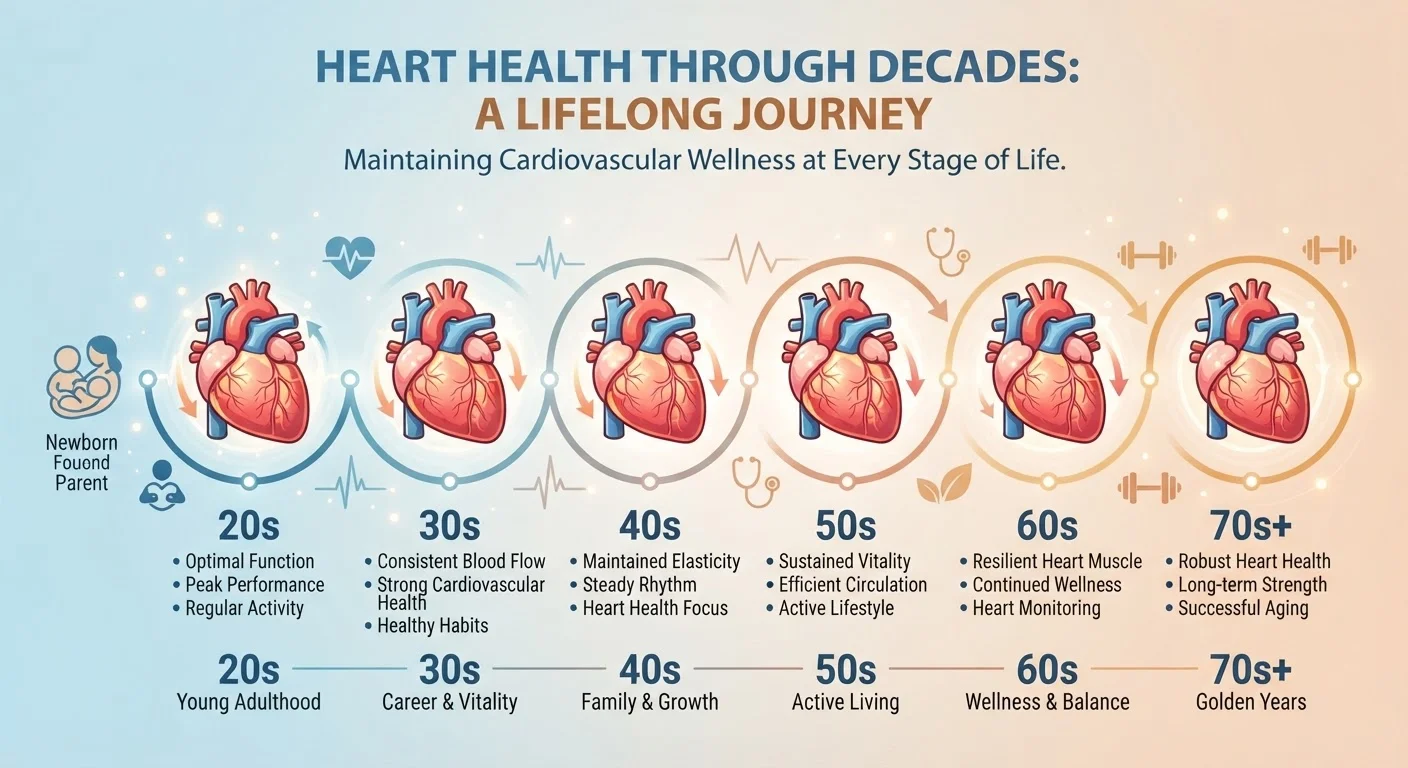
Understanding how risk shifts across decades gives individuals and their clinicians a clearer framework for knowing which screenings to prioritize, which symptoms to take seriously, and when lifestyle changes carry the most leverage. The list below walks through each major life decade, from the 30s to the 70s, highlighting the cardiovascular concerns most relevant at each stage.
It's worth noting that individual risk varies considerably. Factors including family history, sex assigned at birth, hormonal status, and existing conditions like diabetes all modify the picture. Learn more about which risk factors are modifiable and which are not to better contextualize where you stand.
Sex, Gender, and Cardiovascular Risk
Cardiovascular risk timelines differ meaningfully between men and women, influenced by hormonal biology, differences in how symptoms present, and historical underrepresentation of women in cardiology research. People with a history of pregnancy-related conditions — such as preeclampsia or gestational diabetes — carry elevated long-term cardiovascular risk that warrants monitoring well after childbirth. If you have concerns related to sex-specific risk, raise them explicitly with your clinician.
Cardiovascular Risk Decade by Decade
Your 30s: Laying the Groundwork — for Better or Worse
For most people, the 30s feel too early to worry about heart disease. Clinically, this intuition is partially justified — acute cardiovascular events in this decade are uncommon. However, the processes underlying atherosclerosis (the buildup of plaques inside artery walls) are already underway in many adults by their mid-30s.
Key concerns in this decade include early-onset hypertension, which affects a growing proportion of younger adults, and the beginning of metabolic shifts that raise insulin resistance. Smoking, physical inactivity, and a diet high in processed foods accelerate these processes significantly. Stress — chronic occupational or psychological stress — is increasingly recognized as an independent risk factor, partly through its effects on blood pressure and inflammatory markers.
The 30s are also when establishing a relationship with a primary care provider and beginning baseline screenings (blood pressure, cholesterol, blood glucose) creates the most long-term value.
Atherosclerosis can begin silently in your 30s, long before any symptoms are felt.
Your 40s: Hypertension and Metabolic Risk Take Centre Stage
The 40s mark a significant inflection point. Prevalence of hypertension rises sharply in this decade, and for many people this is when elevated blood pressure is first diagnosed — often incidentally during a routine check. Because hypertension rarely causes noticeable symptoms, it earns the label 'silent killer' for good reason.
Metabolic syndrome — a cluster of conditions including abdominal obesity, elevated triglycerides, low HDL cholesterol, high blood pressure, and elevated fasting glucose — becomes more common in the 40s and meaningfully increases cardiovascular risk. Understanding the full cholesterol picture, including LDL particle size and triglyceride levels, is more informative than total cholesterol alone at this stage.
For men, the 40s represent a period of accelerating risk relative to women of the same age, a disparity explored in detail in the cardiovascular risk gap between men and women.
Hypertension in your 40s rarely announces itself — routine screening is how it gets caught.
Your 50s: Menopause, Arterial Stiffening, and Rising Event Risk
The 50s bring a biological shift that dramatically alters cardiovascular risk for women: menopause. The decline in estrogen is associated with less favorable lipid profiles, increased blood pressure, greater central adiposity, and accelerated arterial stiffening. Within roughly a decade of menopause, women's cardiovascular risk approaches that of men the same age.
For both sexes, arterial stiffness — measured by pulse wave velocity in clinical research — increases during the 50s, contributing to higher systolic blood pressure and greater cardiac workload. This decade is also when prior decades of suboptimal sleep, sedentary behavior, or poorly controlled diabetes begin to show more clearly in cardiovascular biomarkers.
Individuals with type 2 diabetes require particularly careful cardiovascular monitoring in their 50s, as diabetes roughly doubles the risk of heart disease and is associated with more diffuse coronary artery disease.
Menopause triggers cardiovascular changes that can close the risk gap between men and women within a decade.
Your 60s: Cumulative Risk, Multimorbidity, and Medication Complexity
By the 60s, a significant proportion of adults are managing multiple chronic conditions simultaneously — hypertension, type 2 diabetes, chronic kidney disease, and heart disease frequently coexist. This multimorbidity complicates cardiovascular management, since treatment decisions must account for drug interactions, competing risks, and organ function changes that come with age.
Coronary artery disease becomes more clinically apparent in this decade, and atrial fibrillation (AFib) — an irregular heart rhythm that significantly increases stroke risk — begins to rise in prevalence. Symptoms of heart disease in older adults can present atypically: instead of classic chest pain, individuals may experience fatigue, shortness of breath, or confusion, which can lead to diagnostic delays.
Statin therapy, antihypertensive medications, and anticoagulants are commonly prescribed in this decade. Adherence to prescribed regimens, and open communication with clinicians about side effects, is a meaningful factor in cardiovascular outcomes. Never start, stop, or modify medications without professional guidance.
In your 60s, heart disease symptoms can be atypical — fatigue or breathlessness rather than chest pain.
Your 70s: Heart Failure, Frailty, and Reframing Goals of Care
Heart failure — a condition in which the heart cannot pump or fill efficiently enough to meet the body's demands — is among the most common cardiovascular diagnoses in adults over 70. It is distinct from a heart attack and is often chronic and progressive. Understanding the difference between heart failure and heart attack is particularly important for older adults and their caregivers.
Frailty — characterized by reduced muscle mass, fatigue, low physical activity, and slow gait speed — intersects with cardiovascular risk in complex ways. Frail older adults may tolerate aggressive cardiovascular interventions less well, meaning that clinical decision-making in the 70s increasingly weighs functional quality of life alongside traditional risk reduction targets.
Cardiac rehabilitation programs, structured physical activity, and dietary support remain evidence-based components of care in this decade. Conversations with clinicians about individualized goals — what outcomes matter most to the patient — become especially important when managing cardiovascular disease in the context of aging.
Heart failure is common past 70, but structured cardiac rehabilitation can meaningfully support quality of life.
Schedule Screenings Before Symptoms Appear
Most cardiovascular conditions that develop across the 40s, 50s, and 60s are detectable through routine screenings — blood pressure checks, lipid panels, fasting glucose, and ECGs — before they cause symptoms. Talking with your primary care provider about your personal risk profile and appropriate screening intervals is one of the highest-yield steps you can take at any age. Don't wait for warning signs to start the conversation.
Acting on What You Know
One of the most consistent findings in cardiovascular research is that prevention compounds over time. Interventions that might seem minor — maintaining a healthy weight, not smoking, keeping blood pressure within normal range — significantly reduce lifetime risk when sustained across decades. The myths surrounding heart disease often give people false confidence or unnecessary fatalism; neither serves long-term health.
If you're navigating heart health concerns alongside other chronic conditions, how chronic conditions shift with age offers useful broader context. And because physical activity remains one of the best-evidenced cardiovascular protections at every age, understanding how exercise needs evolve through each decade is a practical complement to this guide.
This article is for general informational and educational purposes only and does not constitute medical advice. Always consult a qualified healthcare professional for guidance specific to your health history, symptoms, or treatment decisions.
The content on this site is for informational purposes only and is not a substitute for professional advice. Always consult a qualified professional for guidance specific to your situation.