
Why Muscle Loss Speeds Up After 60
The biology of age-related muscle loss is multifactorial. By the time a person reaches their 60s, several converging processes have been building for decades — and they begin reinforcing each other in ways that noticeably accelerate decline.
Hormonal shifts play a central role. Testosterone, estrogen, growth hormone, and insulin-like growth factor 1 (IGF-1) all contribute to muscle protein synthesis. Each declines with age, reducing the body's anabolic — or muscle-building — signaling capacity. After menopause, women face a sharper hormonal transition that can speed this process. Men experience a more gradual testosterone decline but are not exempt.
Reduced anabolic sensitivity compounds the hormonal picture. Older muscle tissue becomes less responsive to the protein and exercise signals that stimulate repair and growth. This phenomenon, called "anabolic resistance," means that an older adult may need more protein and more mechanical stimulus to achieve the same muscle-building response as a younger person.
Neuromuscular changes also matter. Aging leads to the loss of fast-twitch motor units — the nerve-muscle connections responsible for power and rapid force production. This is partly why older adults notice a decline not just in strength but in reaction time and explosive movement capability.
Finally, inactivity creates a vicious cycle. Reduced strength leads to less activity, which leads to further muscle loss. Illness, injury, or hospitalization can accelerate this dramatically — even short periods of bed rest cause disproportionate muscle wasting in older adults compared to younger people.
Sarcopenia Has a Formal Clinical Definition
Sarcopenia is recognized as a disease entity by the International Classification of Diseases (ICD-10). It is diagnosed using objective measures of muscle mass and physical performance, not simply by subjective feelings of weakness or fatigue. If you are concerned about your muscle health, a conversation with your physician — who may refer you to a geriatric specialist or physical therapist — is the appropriate first step.
What the Research Says About Slowing Sarcopenia
The evidence is clear that sarcopenia is not simply something to accept. Two interventions have the strongest and most consistent research support: progressive resistance training and adequate dietary protein.
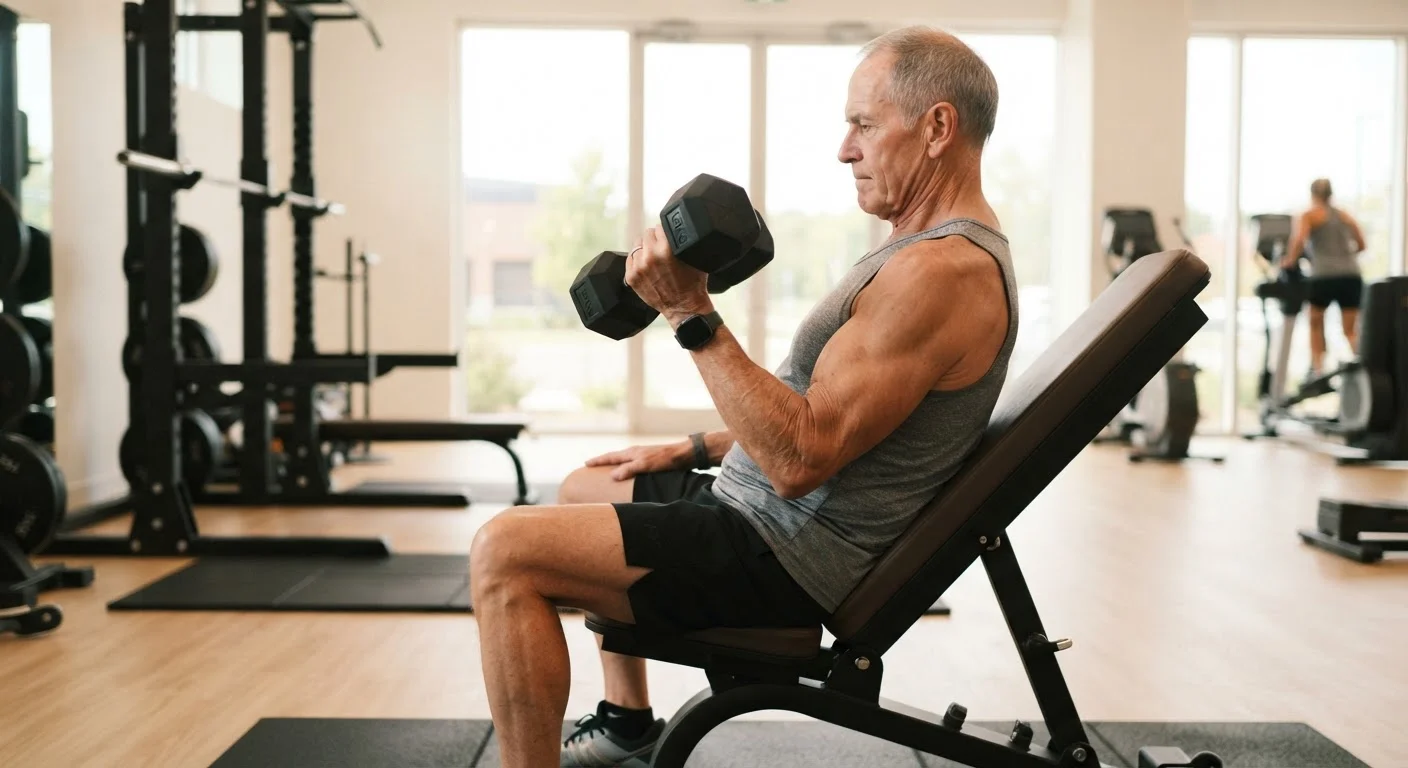
Resistance training works by creating mechanical tension in muscle fibers, which triggers repair and adaptation even in aging tissue. Studies including adults well into their 80s have documented meaningful increases in muscle mass and strength from supervised resistance programs. The key word is progressive — gradually increasing the load over time is essential to continued adaptation. This is consistent with what we know about how the body responds to physical challenge at any age. See our explanation of how exercise adaptation works for more context.
Protein intake directly supports muscle protein synthesis. Research suggests that older adults generally require more dietary protein than younger adults to achieve the same anabolic response — a direct consequence of anabolic resistance. Distributing protein intake across meals (rather than concentrating it in one sitting) appears to optimize muscle protein synthesis throughout the day, based on current evidence.
Spread Protein Across the Day
Rather than consuming most of your protein at one meal, aim to include a meaningful protein source at each meal. Research suggests this approach better supports muscle protein synthesis in older adults, whose muscles are less efficient at using large protein boluses delivered infrequently. A healthcare provider or registered dietitian can help you determine an appropriate target based on your individual health needs.
It is also worth addressing a persistent misconception: that it is too late to start, or that exercise is dangerous for older joints. The evidence does not support either claim. Common exercise myths about aging often prevent older adults from accessing benefits that research consistently confirms are available to them.
3–8%
Muscle mass lost per decade after age 30
This estimate is widely cited in gerontology literature, with the rate accelerating meaningfully after age 60 in sedentary individuals.
~10–15%
Strength gain possible in older adults from resistance training
Multiple clinical trials have documented significant strength improvements in adults over 60 following progressive resistance training programs, even in those over 80.
Up to 30%
Reduction in fall risk with targeted exercise programs
The World Health Organization and other public health bodies cite multi-component exercise programs — including balance and strength work — as among the most effective fall prevention strategies for older adults.
Practical Implications for Older Adults
Translating this research into daily life requires some structure, but it does not require extreme effort or specialized equipment. The fundamentals are accessible.
Resistance exercise two to three times per week targeting major muscle groups — legs, back, chest, and shoulders — is the clinical standard recommended by bodies including the American College of Sports Medicine. For those new to structured exercise, a practical introduction to strength training can provide a safe starting point regardless of gender.
Mobility and flexibility work complements resistance training by supporting the range of motion needed to exercise safely and move confidently. Understanding how flexibility declines with age can help inform a more complete movement routine.
Beyond exercise, fall prevention is a meaningful clinical goal. Maintaining lower-body strength and balance directly reduces fall risk — one of the most serious threats to independence in older adults. Programs that combine strength, balance, and functional movement have shown particular promise in this area.
For those earlier in midlife, it is worth noting that the groundwork laid now significantly influences outcomes later. Muscle changes often begin earlier than expected, making earlier intervention advantageous — though it is never too late to start.
This article is for general informational purposes only and does not constitute medical advice. Always consult a qualified healthcare professional before starting a new exercise program, particularly if you have chronic conditions, recent injuries, or other health concerns.
Frequently Asked Questions
Muscle mass begins declining gradually from around age 30, with losses of roughly 3–8% per decade. After age 60, this rate typically accelerates, and some estimates suggest losses of up to 15% per decade in sedentary older adults. Individual variation is considerable depending on activity level, nutrition, and health status.
Yes. Research consistently shows that adults in their 60s, 70s, and even 80s can increase muscle mass and strength in response to resistance training. The gains may be more modest than in younger adults, but they are clinically meaningful for function and independence.
Many researchers and clinical guidelines suggest older adults benefit from higher protein intake than the general recommended dietary allowance — often cited in the range of 1.2 to 1.6 grams per kilogram of body weight per day. However, individual needs vary, and anyone with kidney disease or other conditions should discuss protein intake with their healthcare provider.
Not exactly. Some degree of muscle change is a normal part of aging, but sarcopenia describes a clinically significant loss that impairs strength and physical performance. It is a recognized medical condition, not simply an unavoidable aspect of getting older.
Progressive resistance training — using free weights, machines, resistance bands, or bodyweight — has the strongest evidence for preserving and rebuilding muscle mass in older adults. Combining this with aerobic activity supports overall functional capacity and cardiovascular health.
Both sexes experience sarcopenia, though the trajectory can differ. Women often experience accelerated muscle loss in the years following menopause due to declining estrogen levels, while men see gradual reductions tied to falling testosterone. Both benefit from the same core interventions: resistance exercise and adequate protein.
The content on this site is for informational purposes only and is not a substitute for professional advice. Always consult a qualified professional for guidance specific to your situation.