

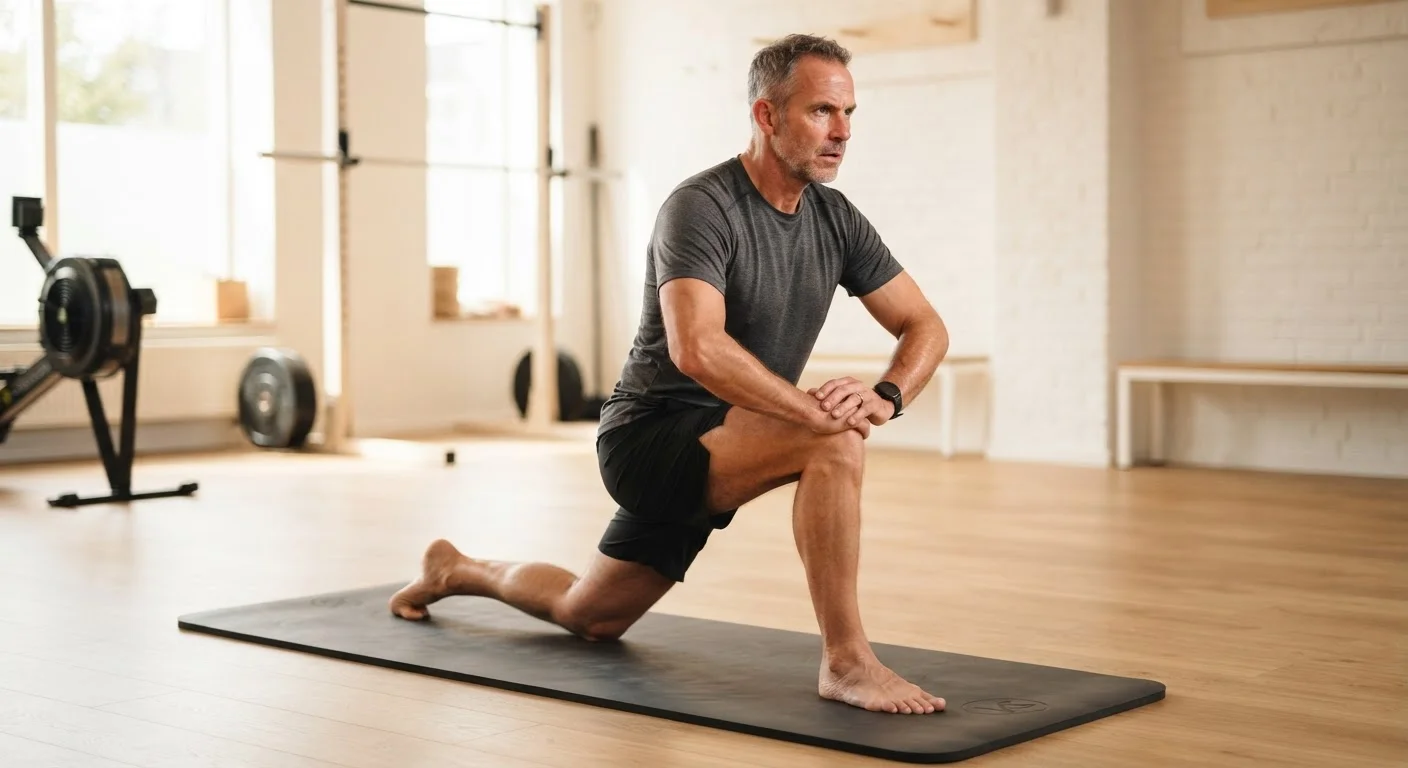
Why Men Lose Flexibility Faster
Flexibility — the passive range of motion a joint or muscle can achieve — tends to decline earlier and more sharply in men than in women. Several converging factors explain this. Men generally have denser muscle mass and greater muscle cross-sectional area, which can limit the extensibility of surrounding fascia and connective tissue. Testosterone, while critical for muscle development, does not promote the tissue elasticity that estrogen helps sustain in women.
Structural differences also matter. Men typically have tighter hip flexors, hamstrings, and thoracic spine — regions heavily taxed by sedentary work and compensatory movement patterns. Research consistently shows that without deliberate maintenance, joint range of motion decreases progressively from the mid-30s onward. This isn't just about comfort: reduced flexibility is associated with higher injury risk, diminished athletic performance, and — over decades — meaningful reductions in functional independence. For a broader look at what's happening concurrently to muscle tissue, see what men should expect after 30 with muscle mass.
Understanding the distinction between flexibility and mobility is also important. Mobility refers to active, controlled range of motion — movement you can own through strength and coordination, not just passive stretch. Both qualities matter as you age and require separate training approaches.
The Behavioural Amplifiers: Posture, Inactivity, and Recovery Neglect
Biology sets the baseline, but behaviour largely determines how fast decline occurs. Extended sitting — the default posture for many working men — shortens hip flexors, tightens the posterior chain, and rounds the thoracic spine. When these positions become habitual, the nervous system treats them as the new neutral, making full-range movement increasingly uncomfortable and unfamiliar.
Many men also deprioritise recovery practices. Stretching and mobility work are frequently skipped in favour of additional sets in the weight room or simply omitted due to time pressure. Unlike strength or cardiovascular fitness, flexibility loss is gradual and largely painless until it isn't — which means it often goes unaddressed until stiffness becomes restriction. Early signs of declining mobility are worth recognising before they compound.
Pain Is Not the Same as Productive Stretch
Feeling tension during a stretch is expected and appropriate. Sharp, stabbing, or joint-based pain during flexibility work is not. If you consistently experience pain — rather than simple muscular discomfort — during or after stretching, that warrants evaluation by a physiotherapist or sports medicine physician rather than simply pushing through. Overstretching damaged or inflamed tissue can worsen rather than resolve restriction.
Best Practices for Preserving Flexibility and Mobility
The research on stretching is more nuanced than the conventional wisdom suggests. Here are evidence-informed practices that genuinely move the needle:
Use dynamic stretching before exercise, static stretching after.
Dynamic stretching — controlled, movement-based ranges — prepares joints and raises tissue temperature before training without reducing force output. Static stretching held after exercise, when tissues are warm, produces the greatest gains in passive flexibility over time.
Prioritise the hips, thoracic spine, and ankles — the regions men lose fastest.
These three areas are both anatomically prone to restriction in men and disproportionately responsible for movement quality across the whole body. Tightness in any one of them forces compensation patterns upstream and downstream.
Hold static stretches for at least 30–60 seconds per position.
Research suggests that durations shorter than 30 seconds produce limited long-term change in resting muscle length. The nervous system requires sustained, repeated input to reduce its protective resistance to stretch over weeks and months.
Incorporate loaded mobility work, not just passive stretching.
Mobility trained under light load — through exercises like deep goblet squats, Jefferson curls, or controlled active flexibility drills — builds usable range of motion that passive stretching alone cannot fully replicate. It teaches the nervous system to trust the new range.
Break up sedentary time with targeted movement breaks every 60–90 minutes.
Sustained static postures — particularly prolonged sitting — progressively shorten soft tissue and signal the nervous system to adopt restricted positions as normal. Regular movement interruptions prevent these patterns from calcifying.
Be consistent over weeks and months rather than intensive in isolated sessions.
Connective tissue adapts slowly. Infrequent, aggressive stretching sessions produce less lasting change than shorter, daily sessions maintained over time. Frequency and consistency outperform intensity when the goal is tissue remodelling.
This article is for general informational and educational purposes only and does not constitute medical advice. Consult a qualified healthcare professional before beginning a new exercise programme, particularly if you have existing joint, connective tissue, or mobility concerns.
Building It Into Your Life Long-Term
Preservation of flexibility is a long-game commitment. Men who maintain range of motion into their later decades typically do so not through heroic flexibility sessions but through steady, integrated habits — a few minutes of dynamic warm-up before activity, deliberate position changes throughout the workday, and a consistent evening routine targeting the hips, thoracic spine, and posterior chain.
“Flexibility is less a gift you're born with and more a resource you either maintain or lose. Most people don't notice the slow withdrawal until the account is nearly empty.”
— Kelly Starrett, Physical therapist and author specialising in mobility and movement
For men looking ahead, the payoff extends well beyond athletic performance. Maintained mobility is one of the strongest predictors of functional independence in older age. The comprehensive resource on staying mobile through your 70s and 80s offers a detailed roadmap for what that looks like in practice. More broadly, flexibility sits alongside stability and strength as an undertrained pillar of physical health — all three pillars deserve attention in any complete fitness approach.
The content on this site is for informational purposes only and is not a substitute for professional advice. Always consult a qualified professional for guidance specific to your situation.