

Option A
Alzheimer's Disease
The most common form of dementia, driven by protein buildup in the brain.
Best for: Understanding a slowly progressive cognitive condition rooted in amyloid plaques and tau tangles.
Option B
Vascular Dementia
The second most common dementia type, caused by impaired blood flow to the brain.
Best for: Understanding cognitive decline linked to stroke, small vessel disease, or other circulatory events.
Different Origins, Different Damage
Alzheimer's disease and vascular dementia are the two most prevalent forms of dementia in older adults, yet they emerge from entirely distinct biological mechanisms. Understanding this difference matters — not only for diagnosis, but for how each condition is managed and what caregivers can realistically expect.
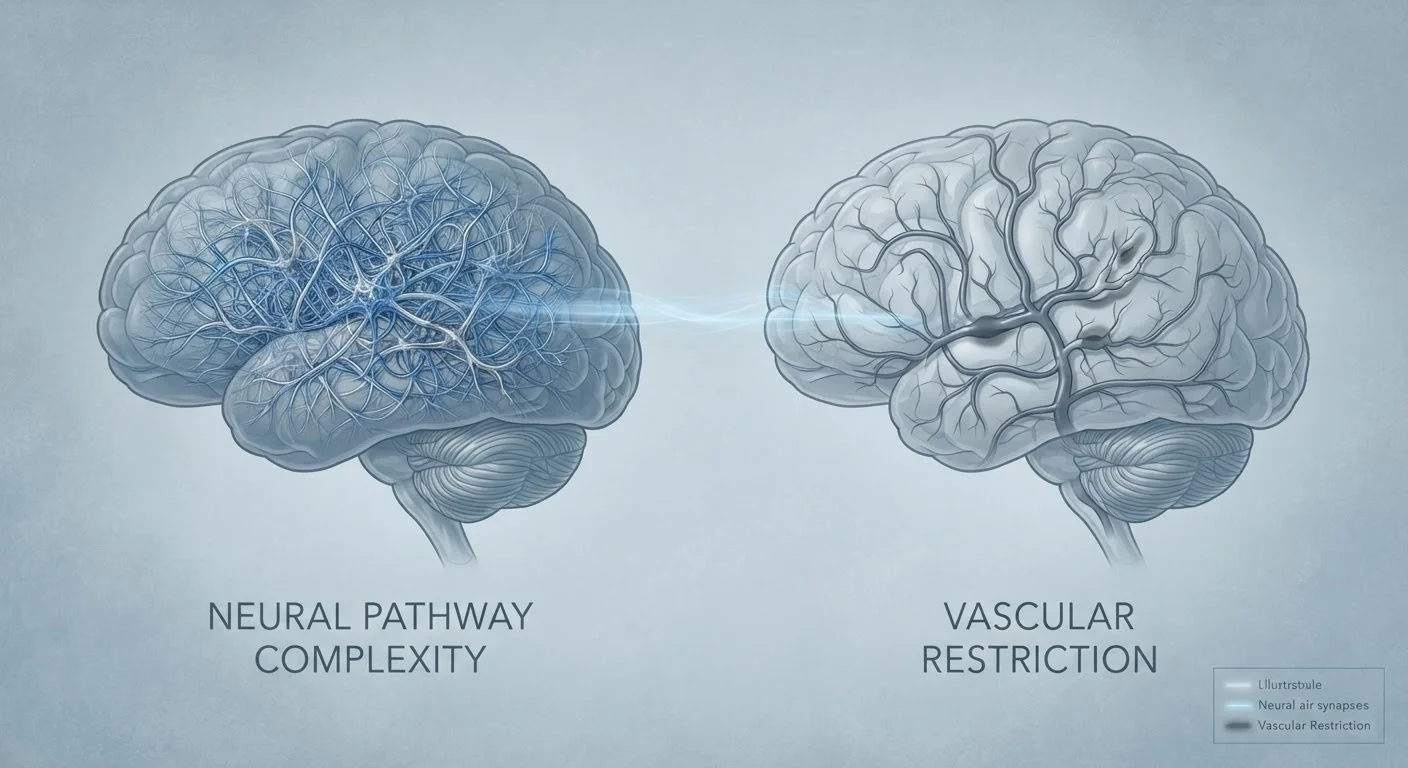
Alzheimer's disease is characterized by the abnormal accumulation of amyloid-beta plaques between neurons and tau protein tangles within them. Over time, these deposits disrupt communication between brain cells and trigger widespread cell death. The hippocampus — the brain's primary memory center — is typically affected early, which is why short-term memory loss is often the first noticeable sign. The underlying process begins years, possibly decades, before symptoms appear.
Vascular dementia, by contrast, results from conditions that reduce or block blood flow to parts of the brain, depriving tissue of oxygen and nutrients. This can occur after a major stroke, a series of smaller strokes (sometimes called multi-infarct dementia), or through the gradual damage of small vessel disease — a process where the tiny arteries deep in the brain narrow over time. The cognitive areas affected depend on which brain regions lose adequate circulation.
For a broader framework of how these diagnoses relate to each other, see dementia, Alzheimer's, and mild cognitive impairment explained.
| Criterion | Alzheimer's Disease | Vascular Dementia |
|---|---|---|
| Primary cause | Amyloid plaques & tau tangles | Reduced or blocked brain blood flow |
| Typical progression | Slow, continuous decline | Stepwise or sudden worsening |
| Early hallmark symptom | Short-term memory loss | Slowed thinking, poor planning |
| Key risk factors | Age, genetics (APOE ε4), family history | Hypertension, diabetes, stroke, smoking |
| Brain imaging findings | Cortical atrophy, hippocampal shrinkage | White matter changes, infarcts |
| Modifiable prevention pathway | Limited evidence to date | Cardiovascular risk factor control |
| Can coexist with the other? | Yes — mixed dementia is common | Yes — mixed dementia is common |
How Each Condition Progresses
One of the most clinically meaningful differences between these two conditions is how they unfold over time.
Alzheimer's disease typically follows a gradual, continuous trajectory. Early-stage symptoms — misplacing objects, difficulty with word retrieval, repeating questions — slowly intensify. Middle stages bring increasing difficulty with daily tasks, behavioral changes, and disorientation. Late-stage Alzheimer's involves profound memory loss and loss of physical function. This staged progression, while distressing, does allow families to plan ahead with some predictability.
Vascular dementia often progresses differently: in steps rather than a smooth decline. A person may remain relatively stable for months, then experience a noticeable deterioration — sometimes corresponding to a new vascular event — followed by another period of stability. Some individuals do show a more gradual course, particularly those with small vessel disease, but the stepwise pattern is distinctive enough that clinicians use it as a diagnostic clue.
Early symptoms also differ. Where Alzheimer's classically begins with episodic memory impairment, vascular dementia more frequently presents with slowed thinking, difficulty planning or organizing, and trouble concentrating — sometimes before obvious memory problems emerge. Gait disturbances and urinary symptoms can also appear earlier in vascular dementia than in Alzheimer's.
~60–70%
Share of dementia cases attributed to Alzheimer's
According to the World Health Organization, Alzheimer's disease accounts for approximately 60–70% of all dementia cases globally.
~20%
Dementia cases attributed to vascular causes
Vascular dementia is widely estimated to account for roughly 20% of dementia diagnoses, making it the second most common type after Alzheimer's.
45%+
Alzheimer's autopsies showing vascular co-pathology
Research published in neuropathology literature suggests that more than 45% of people with Alzheimer's-diagnosed dementia also show significant vascular brain changes at autopsy.
It is worth noting that these two conditions frequently coexist. Autopsy studies have found that a significant proportion of people diagnosed with Alzheimer's also show evidence of vascular damage — a pattern termed mixed dementia. This overlap can make definitive diagnosis during life challenging, even for specialists.
For context on distinguishing normal age-related changes from early dementia symptoms, understanding memory changes in later life offers useful guidance.
Risk Factors, Diagnosis, and Care Approaches
The risk factor profiles for these two dementias overlap in some areas but diverge in others. Age is a shared risk factor for both. A family history of Alzheimer's and carrying the APOE ε4 gene variant increase Alzheimer's risk, though having this gene does not guarantee the disease will develop. Vascular dementia shares risk factors with cardiovascular disease: hypertension, type 2 diabetes, high cholesterol, smoking, atrial fibrillation, and prior stroke or heart disease all substantially raise the risk.
This distinction matters for prevention. While there is currently no proven way to prevent Alzheimer's disease, there is meaningful evidence that managing vascular risk factors — particularly blood pressure control — may reduce the likelihood and pace of vascular cognitive decline. The connection between heart health and brain health is well-established enough that strategies discussed in distinguishing heart failure from heart attack are directly relevant to vascular dementia risk.
Diagnosis of either condition typically involves cognitive testing, neurological examination, brain imaging (MRI or CT scans), and blood tests to rule out other causes. Brain imaging is particularly valuable: Alzheimer's is associated with cortical atrophy and hippocampal shrinkage, while vascular dementia often reveals white matter changes, old infarcts, or areas of reduced blood flow.
Regarding treatment: no disease-modifying therapy currently halts Alzheimer's progression for most patients, though some medications may temporarily ease symptoms. Vascular dementia has no specific approved drug therapy, but aggressively treating underlying cardiovascular conditions is standard practice. Both diagnoses benefit greatly from structured cognitive engagement, physical activity suited to the individual's condition, and strong caregiver support systems. Anyone concerned about cognitive changes in themselves or a family member should consult a physician or specialist promptly — early assessment allows for better planning, regardless of the diagnosis.
Mixed Dementia: When Both Are Present
Mixed dementia refers to the simultaneous presence of Alzheimer's pathology and vascular brain injury. It is more common than previously recognized, particularly in adults over 80. Because symptoms of the two conditions overlap considerably, mixed dementia can be difficult to distinguish from either condition alone during a person's lifetime. A specialist evaluation — including thorough imaging and cognitive testing — is the most reliable path to understanding what is driving a particular person's symptoms.
This article is for informational purposes only and does not constitute medical advice. Please consult a qualified healthcare professional for evaluation, diagnosis, or guidance specific to your situation.
The content on this site is for informational purposes only and is not a substitute for professional advice. Always consult a qualified professional for guidance specific to your situation.