

What Is Benign Prostatic Hyperplasia?
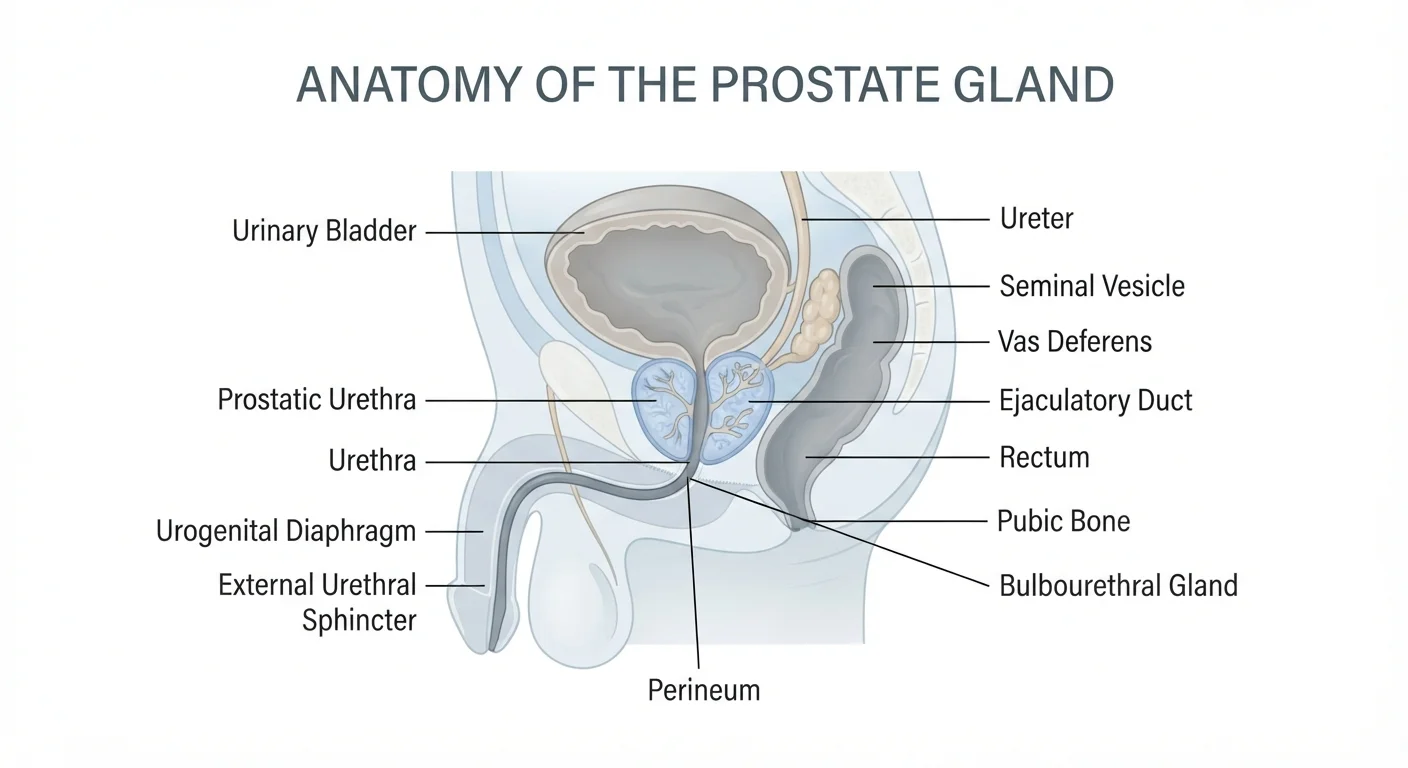
The prostate is a small, walnut-sized gland that sits below the bladder and surrounds the urethra — the tube that carries urine out of the body. Its primary job is to produce seminal fluid. Throughout a man's life, the prostate goes through two main growth phases: once in early puberty and again starting around the mid-20s, a slower, continuous growth that continues for decades.
In many men, this second phase of growth eventually reaches a point where the enlarged prostate presses against the urethra, partially obstructing urine flow. This is benign prostatic hyperplasia. The condition is benign, meaning it carries no malignant potential on its own. It is not a tumor, it does not invade surrounding tissue, and it is not prostate cancer.
For a broader understanding of how the prostate changes throughout life, see Prostate Health Across the Decades — a useful overview of age-related prostate changes and why they matter.
50%+
Men in their 60s affected by BPH
According to the National Institute of Diabetes and Digestive and Kidney Diseases, BPH affects more than half of men in their 60s.
~90%
Men in their 80s with BPH
Prevalence estimates suggest that up to 90% of men in their 80s have some degree of benign prostatic hyperplasia.
1 in 4
Men who will need BPH treatment by age 80
Research suggests that roughly one in four men will require some form of intervention for BPH-related symptoms by the time they reach their 80s.
BPH vs. Prostate Cancer: Key Differences
One of the most important things to understand about BPH is what it is not. Prostate cancer involves uncontrolled, malignant cell growth that can spread beyond the prostate. BPH involves an increase in the total number of normal prostate cells — growth that is orderly, localized, and non-spreading.
The confusion between the two conditions is understandable. Both affect the same organ, both are more common in older men, and both can cause urinary symptoms. They can also exist simultaneously in the same man. That overlap is exactly why men experiencing urinary changes should speak with a healthcare provider rather than self-diagnosing.
PSA (prostate-specific antigen) levels, which are measured via a blood test, can be elevated in both BPH and prostate cancer — another reason a clinical evaluation is essential for accurate interpretation.
BPH and Prostate Cancer Can Coexist
Having BPH does not protect against prostate cancer, and having prostate cancer does not prevent BPH. Because both conditions can be present at the same time and produce similar symptoms, a clinical evaluation — not symptom self-assessment alone — is necessary to distinguish between them. Any new or changing urinary symptoms in men over 50 should be discussed with a healthcare provider.
Recognizing Symptoms and Seeking Care
BPH symptoms are primarily lower urinary tract symptoms (LUTS). These can include:
- A frequent or sudden urge to urinate
- Increased urination at night (nocturia)
- A weak, slow, or intermittent urine stream
- Difficulty starting urination
- A sense that the bladder is not fully empty after urinating
- Dribbling at the end of urination
Not every man with an enlarged prostate experiences significant symptoms. Prostate size does not always correlate directly with symptom severity. Some men with moderately enlarged prostates have minimal symptoms; others with less enlargement experience pronounced urinary disruption.
If urinary symptoms are affecting daily life — disturbing sleep, causing anxiety, or affecting work — a conversation with a primary care physician or urologist is the appropriate first step. Delaying care can allow less common but more serious complications, such as urinary retention or bladder damage, to develop.
Talk to Your Doctor About Urinary Changes
Many men normalize urinary symptoms as an inevitable part of aging and delay seeking care for years. Even mild symptoms are worth mentioning at your next annual check-up. Early evaluation helps rule out other conditions and gives you more management options before symptoms worsen.
Management and Treatment Options
There is no one-size-fits-all approach to managing BPH. Treatment decisions depend on symptom severity, overall health, and individual preferences. Broadly, options fall into three categories:
- Watchful Waiting
- For men with mild symptoms that aren't significantly affecting quality of life, active monitoring with periodic check-ins may be all that's recommended. Lifestyle adjustments — reducing fluid intake before bed, limiting caffeine and alcohol — can provide additional relief.
- Medications
- Several classes of prescription medications are used to relax prostate muscle tissue, reduce prostate size, or both. These are prescribed and managed by a physician based on the individual's symptoms and health profile.
- Procedures and Surgery
- When symptoms are severe or medications are insufficient, minimally invasive procedures or surgery may be considered. These work by removing or reducing excess prostate tissue to relieve urethral obstruction.
This article is for informational purposes only and is not a substitute for professional medical advice, diagnosis, or treatment. Always consult a qualified healthcare provider regarding any medical condition or symptoms.
Frequently Asked Questions
BPH itself does not cause prostate cancer or increase the risk of developing it. However, both conditions affect the same organ, can produce overlapping symptoms, and can coexist in the same man. That's why a doctor will often evaluate both when urinary symptoms arise.
The most common symptoms involve urination: a frequent or urgent need to urinate, a weak or intermittent urine stream, difficulty starting urination, a feeling that the bladder hasn't fully emptied, and waking at night to urinate. Symptom severity varies widely from man to man.
A doctor typically begins with a health history and physical exam, including a digital rectal exam. A PSA blood test, urinalysis, and sometimes a urine flow study may also be used. These tests also help rule out other conditions, including prostate cancer.
Mild BPH symptoms sometimes remain stable or improve without treatment, which is why watchful waiting is a valid approach for many men. However, BPH does not reverse itself, and symptoms can progress over time. A doctor can help determine the best course of management.
Prostate enlargement can begin as early as a man's 40s, but noticeable symptoms are most common after age 50. Prevalence increases significantly with each decade of life, making it one of the most age-related conditions men face.
The content on this site is for informational purposes only and is not a substitute for professional advice. Always consult a qualified professional for guidance specific to your situation.