

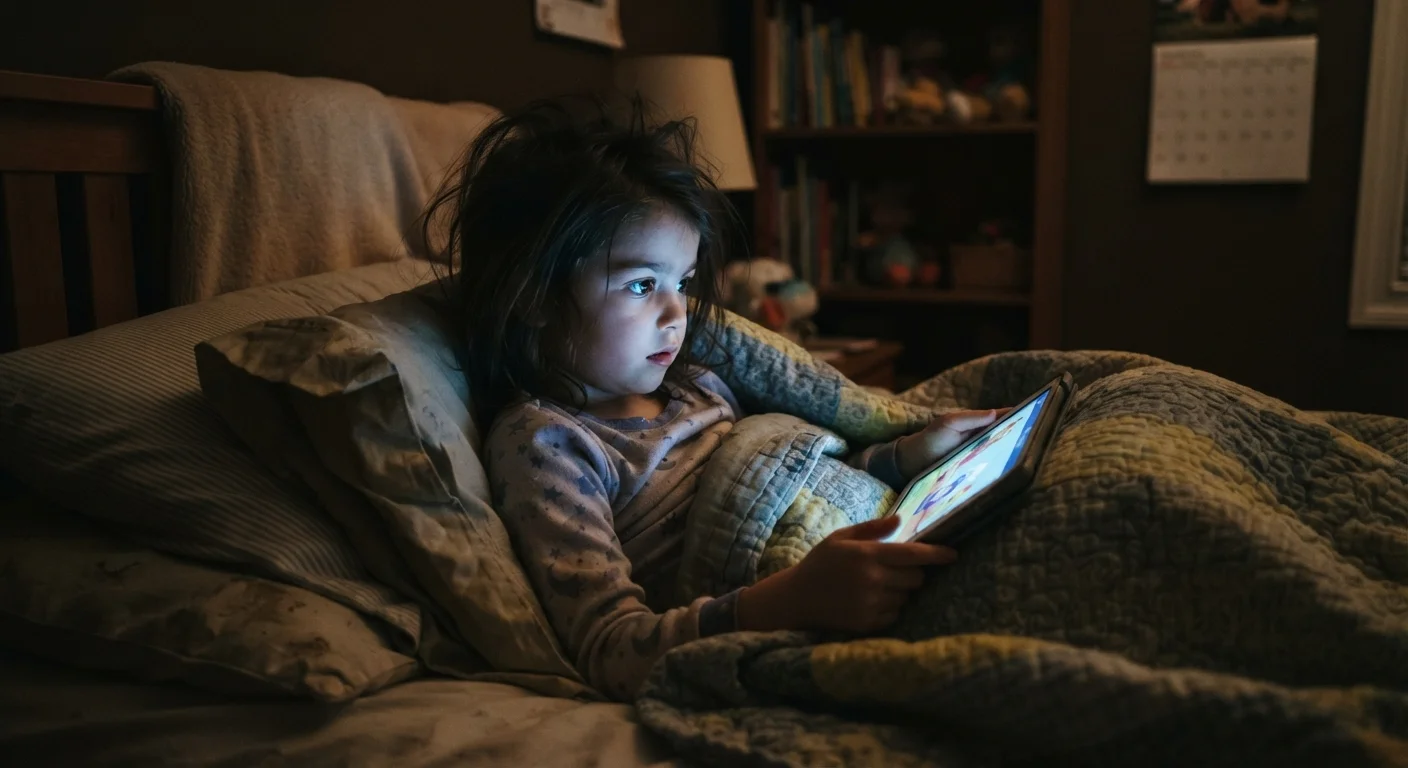
Why the Screen-Sleep Debate Feels So Alarming
Every few months, a new headline warns that screens are robbing children of sleep and harming their development. Parents feel simultaneously guilty and confused — after all, a tablet can mean ten minutes of peace at the end of a chaotic day. The truth is that the research is real but considerably more nuanced than the coverage suggests.
Sleep matters enormously for growing children. The American Academy of Pediatrics (AAP) and the National Sleep Foundation both link adequate, quality sleep to mood regulation, attention, memory consolidation, and physical growth. So when researchers find associations between evening screen use and shorter or disrupted sleep, it is worth taking seriously — without translating a statistical association into a moral panic.
Understanding how screens might affect sleep, and under what conditions, gives parents far more useful guidance than a blunt "no screens after dinner" rule. For a broader look at building good sleep environments, see our sleep hygiene guide.
Myth
Any screen use before bed will ruin my child's sleep.
Fact
Screen use close to bedtime can delay sleep onset, but the impact depends heavily on content type, duration, and the child's individual sensitivity.
The blanket claim that any screen exposure before bed is harmful oversimplifies the evidence. Studies show that interactive, emotionally arousing content (such as competitive gaming or fast-paced social video) is more disruptive than calm, passive viewing. A short, quiet show watched in a well-lit room 30–60 minutes before a consistent bedtime is unlikely to cause the same disruption as hour-long gaming sessions in a dark bedroom. Setting realistic, context-aware limits is more achievable — and more effective — than a zero-tolerance rule that families abandon quickly.
Myth
Blue light from screens is the main reason children can't sleep after screen time.
Fact
Blue light is one contributing factor, but cognitive and emotional arousal from engaging content is often an equally significant disruptor.
Blue light does suppress melatonin, the hormone that signals the body it is time to sleep. However, research suggests that the psychological stimulation from engaging content may delay sleep onset independently of light exposure. Children who watch an emotionally intense video may struggle to settle regardless of whether they use a blue-light filter. This means that blue-light blocking glasses or night-mode settings are helpful supplements — not complete solutions — and that choosing calm content matters just as much as adjusting screen brightness.
Myth
Screens are the main reason children today sleep less than previous generations.
Fact
Sleep duration in children has been declining gradually for over a century — long before smartphones — suggesting multiple societal factors are involved.
Researchers analyzing historical sleep data have found that children's average sleep duration has been shortening since at least the early 1900s. Academic pressures, earlier school start times, increased extracurricular schedules, and household noise levels all contribute. While digital devices represent a newer and meaningful factor, attributing the full decline to screens ignores a complex, multi-decade pattern. Parents who address only screen time while leaving other sleep-disrupting factors unchanged may see little improvement.
Myth
If my child uses screens before bed and still falls asleep fine, there's no problem.
Fact
Children may fall asleep readily but still experience reduced sleep quality or shorter total sleep time that accumulates into a deficit over time.
Sleep onset speed is only one measure of sleep health. Studies using actigraphy — wrist-worn movement sensors that track sleep patterns — have found that children with habitual bedtime screen access sometimes show shortened total sleep duration or more fragmented sleep, even when they appear to fall asleep without difficulty. Chronic mild sleep restriction in children can affect attention, emotional regulation, and behavior in ways that are easy to attribute to other causes. Regular check-ins with a pediatrician can help parents assess whether a child's sleep is genuinely restorative, not just apparently adequate.
Myth
Removing all devices from a child's room will solve sleep problems.
Fact
Device removal helps, but sleep problems in children are usually multifactorial and benefit most from a consistent overall bedtime routine.
Device-free bedrooms are a reasonable, evidence-informed recommendation from the AAP and other pediatric bodies. However, if a child's bedroom is too warm, their schedule is irregular, or they are experiencing anxiety, removing a device alone may produce only modest improvements. Research on sleep interventions in children consistently shows that a predictable wind-down routine — same bedtime, calming activities, darkness, and cool temperature — has the strongest effect on sleep duration and quality. Screen limits work best as one component of a broader routine, not as an isolated fix. Our sleep hygiene guide outlines how to build that routine effectively.
What the Evidence Actually Supports
Research consistently finds that children who use screens in the hour before bed tend to take longer to fall asleep and sleep fewer hours overall. A large meta-analysis published in JAMA Pediatrics examined studies across multiple countries and found that bedtime device access was associated with shorter sleep duration, poorer sleep quality, and more daytime sleepiness. These are meaningful findings — but the effect sizes vary considerably, and correlation does not establish that screens are the sole or even primary culprit.
75%
Children with a device in their bedroom
A review in JAMA Pediatrics found approximately 75% of children have access to a screen device in their bedroom at night, which was associated with shorter sleep duration.
~20–30 min
Average sleep lost per night with bedtime device access
Multiple studies cited in sleep research literature estimate children with bedtime device access sleep roughly 20–30 minutes less per night on average compared to those without.
9–11 hrs
Recommended nightly sleep for school-age children (6–12 yrs)
The American Academy of Sleep Medicine, endorsed by the AAP, recommends 9–11 hours of sleep per night for children aged 6–12 years.
Several mechanisms are plausible. Blue-wavelength light from screens suppresses melatonin production, which can delay the body's internal cue to sleep. High-engagement content — fast-paced videos, social interactions, competitive games — can elevate arousal and make it harder to wind down. And devices used in bed displace time that might otherwise be spent in quieter, sleep-promoting activities.
Importantly, passive, slow-paced content in a well-lit room appears to have a smaller impact than interactive, emotionally stimulating use in a darkened bedroom. Context, timing, and content type all shape the outcome. For parents interested in how these same mechanisms affect adults, common sleep myths is a useful companion read.
This article is for general informational purposes only and does not constitute medical advice. If you have concerns about your child's sleep, please speak with your child's pediatrician or a qualified healthcare professional.
The content on this site is for informational purposes only and is not a substitute for professional advice. Always consult a qualified professional for guidance specific to your situation.