

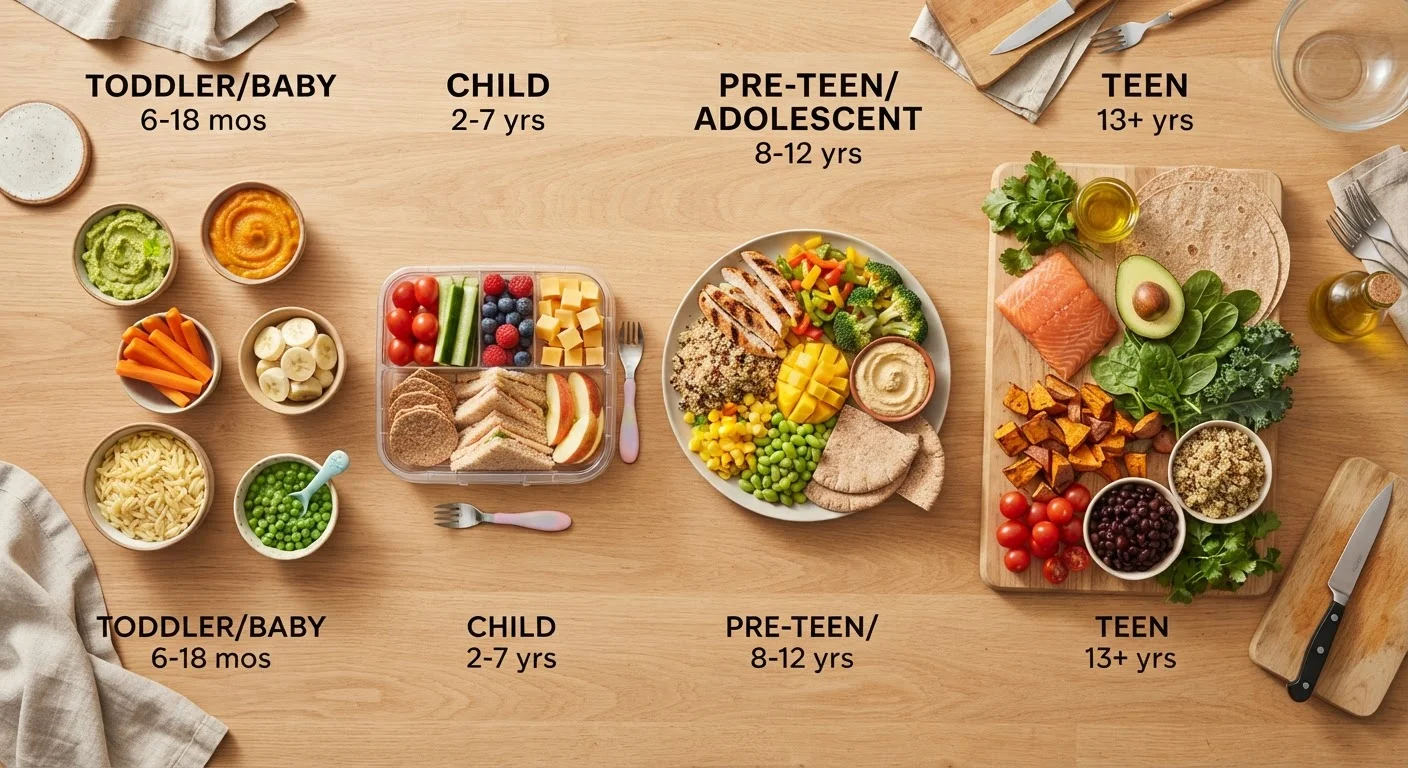
Why Childhood Nutrition Is Not One-Size-Fits-All
A child's body is never finished growing — and neither are its nutritional demands. From the rapid brain development of the toddler years to the skeletal surge of puberty, each stage calls for a different balance of energy, macronutrients, and micronutrients. What's adequate for a 3-year-old can fall well short of what a 15-year-old needs.
Understanding these shifts helps parents make informed choices at the dinner table without guesswork or anxiety. This guide walks through key nutritional priorities at each stage — and flags the gaps that most commonly go unmet. For foundational principles that apply across all ages, see our Nutrition Basics hub.
95%
U.S. children not meeting vegetable intake goals
According to the Dietary Guidelines for Americans, the vast majority of children fall short of recommended daily vegetable servings.
1,300 mg
Daily calcium needed by children ages 9–18
The National Institutes of Health sets this target for peak bone-mass accumulation during the critical pre-teen and teen years.
~10%
Teen girls affected by iron-deficiency anemia
Research estimates that roughly 1 in 10 adolescent girls in the United States has iron-deficiency anemia, largely due to menstrual losses and dietary patterns.
Toddlers (Ages 1–3): Building Blocks and Big Transitions
The transition from breast milk or formula to family foods is one of the most significant dietary shifts a child will experience. Toddlers need nutrient-dense foods in small, frequent amounts — their stomachs are roughly the size of their fists.
Key priorities
- Iron: Growth demands increase iron needs at this stage. Red meat, iron-fortified cereals, beans, and lentils are practical sources. Pairing iron-rich plant foods with vitamin C enhances absorption.
- Calcium and vitamin D: Both support the rapid bone-building happening during these years. Dairy foods, fortified plant milks, and limited safe sun exposure contribute to vitamin D status.
- Healthy fats: The brain grows rapidly through age 3. Fat should not be restricted at this stage; sources such as avocado, full-fat dairy, and eggs support neurological development.
- Fiber: Introduce a variety of fruits, vegetables, and whole grains. The American Academy of Pediatrics (AAP) recommends against excessive fruit juice, which displaces fiber-rich whole foods.
Picky eating is extremely common at this age and rarely signals a nutritional problem on its own. Our article on when a child refuses to eat explains how to tell typical behavior from patterns worth discussing with a provider.
Make Variety the Goal, Not Perfection
No single meal needs to be nutritionally complete. Aim for variety across the week — different colored vegetables, different protein sources, and different grains. This approach reduces mealtime stress for parents and models a healthy relationship with food for children.
Preschool and Early School Age (Ages 4–8): Establishing Habits
Growth slows relative to the toddler years, and appetites often reflect that — don't be alarmed if a previously enthusiastic eater becomes more selective. Calorie needs increase modestly, and variety becomes increasingly important as a long-term habit builder.
Key priorities
- Whole grains: At least half of grain servings should come from whole sources. Oats, whole-wheat bread, and brown rice provide fiber and B vitamins.
- Protein variety: Children in this range benefit from exposure to diverse protein sources — poultry, fish, eggs, legumes, and nuts (if no allergy). Variety also helps establish openness to different foods.
- Calcium: Bone mineral density continues to accumulate. Dairy, fortified alternatives, and leafy greens all contribute.
- Limiting added sugars: The Dietary Guidelines for Americans recommend that children under 2 avoid added sugars entirely, and older children consume as little as possible. Sweetened beverages are the top source of added sugar in children's diets.
This is also a good time to introduce children to where food comes from — involving kids in simple meal prep has been associated in research with greater vegetable acceptance.
Middle Childhood (Ages 9–11): Growth Steadies, Needs Sharpen
The years just before puberty represent a window of relative nutritional stability — but also preparation. Bone density accumulates rapidly, and nutrient stores built now directly influence health through the adolescent growth spurt and beyond.
Key priorities
- Calcium and vitamin D: Requirements rise to 1,300 mg of calcium per day for children 9 and older (per the National Institutes of Health). Dairy and fortified foods remain the most practical sources for most families.
- Iron: Girls approaching menarche (first menstrual period) may benefit from increased attention to iron intake, as monthly losses begin to affect stores.
- Fiber: Most children in this age group consume far less fiber than recommended. Beans, whole fruits, vegetables, and whole grains all contribute meaningfully.
Growth chart patterns at annual check-ups can provide useful context for whether a child's nutrition and development are on track.
Offer new foods alongside familiar favorites rather than as replacements — repeated, low-pressure exposure is what builds acceptance over time, not a single forced introduction.
Research consistently shows that children may need 10–15 exposures to a new food before accepting it; pairing it with something already liked reduces mealtime conflict.
For pre-teen athletes, prioritize iron and calcium through food before turning to supplements — whole food sources come packaged with cofactors that improve absorption.
Nutrients like vitamin C (found in citrus, bell peppers) enhance non-heme iron absorption, while dietary fat helps the body absorb fat-soluble nutrients like vitamin D, benefits that isolated supplements don't always replicate.
Adolescence (Ages 12–18): The Nutritional Surge
Puberty triggers the most dramatic nutritional demands of the entire childhood period. Bone mass, muscle, and organ size all increase rapidly, and calorie needs can rival or exceed those of active adults — particularly for boys in mid-puberty.
Key priorities
- Calcium: Peak bone mass is largely set during adolescence. Consistently meeting the 1,300 mg daily recommendation during these years has lasting implications for bone health in adulthood.
- Iron: Menstruating teens have significantly elevated iron needs. Iron-deficiency anemia is notably common in adolescent girls and can affect energy, concentration, and athletic performance.
- Protein: Muscle development requires adequate protein. Most teens in Western countries meet protein needs through diet, but athletic teens with high training loads may benefit from careful attention to total intake — a registered dietitian can help assess this.
- Zinc: Often overlooked, zinc supports growth, immune function, and sexual maturation. Meat, shellfish, legumes, and seeds are good sources.
Teens are also increasingly making independent food choices, which makes family mealtime, positive food modeling, and open conversations about eating all the more valuable. For a parallel look at how nutrient needs shift across adult decades, see our overview of key vitamins and minerals for adults.
Watch for Disordered Eating in Teens
Adolescence is the peak window for the emergence of eating disorders. Significant food restriction, rigid food rules, excessive concern about weight, or avoiding meals with others are patterns worth raising with a healthcare provider promptly. Early intervention is strongly associated with better outcomes.
Common Nutritional Gaps Across All Ages
Certain nutrients are consistently under-consumed across all childhood age groups, regardless of otherwise balanced eating:
- Vitamin D: Most children, particularly those in northern latitudes or with limited sun exposure, do not obtain sufficient vitamin D from diet alone. The AAP recommends that all children who don't consume adequate vitamin D through food discuss supplementation with their provider.
- Fiber: Average fiber intake in children is well below recommended levels at every age. Practical increases come from swapping refined grains for whole grains, adding beans to familiar dishes, and prioritizing whole fruit over juice.
- Potassium: Fruit, vegetable, and legume intake — the main dietary sources — remains low for many children, contributing to potassium gaps.
- Calcium: Especially as dairy is replaced by sweetened beverages in the teen years.
Families exploring plant-based eating should be especially attentive to vitamin B12, iron, zinc, and omega-3s. Our article on plant-based eating and nutritional trade-offs covers this in depth. Just as nutrition needs shift throughout human childhood, similar patterns emerge in other species — our guide on pet health across life stages draws a useful parallel for pet owners.
Supplements Are Not a Substitute for Diet
Multivitamins and targeted supplements can help fill documented gaps, but they are not a replacement for a varied, balanced diet. Whole foods contain fiber, antioxidants, and phytonutrients that supplements cannot replicate. Discuss any supplement use with your child's pediatrician before starting, as some nutrients can be harmful in excess.
When to Talk to a Pediatric Healthcare Provider
General nutrition guidance is a useful starting point, but every child is an individual. The following situations warrant a conversation with a pediatrician or registered pediatric dietitian:
- Persistent growth faltering or unexpected weight changes flagged on a growth chart
- A restrictive diet (vegan, elimination diet, or food-allergy-driven restriction) that limits several food groups
- Signs of iron-deficiency anemia: unusual fatigue, pallor, or difficulty concentrating
- A teen showing signs of disordered eating or significant anxiety around food
- Questions about dietary supplements — appropriate types and amounts vary by age and health status
Alongside nutrition, physical activity and adequate sleep form the foundation of children's health at every stage. No single factor operates in isolation.
“The foods children eat today shape not only their growth right now, but their chronic disease risk decades from now. Building dietary variety early is one of the most powerful long-term health investments a family can make.”
— Walter Willett, Professor of Epidemiology and Nutrition, Harvard T.H. Chan School of Public Health
This article is for general informational purposes only and is not a substitute for personalized medical or nutritional advice. Always consult a qualified healthcare provider regarding your child's specific dietary needs.
The content on this site is for informational purposes only and is not a substitute for professional advice. Always consult a qualified professional for guidance specific to your situation.