

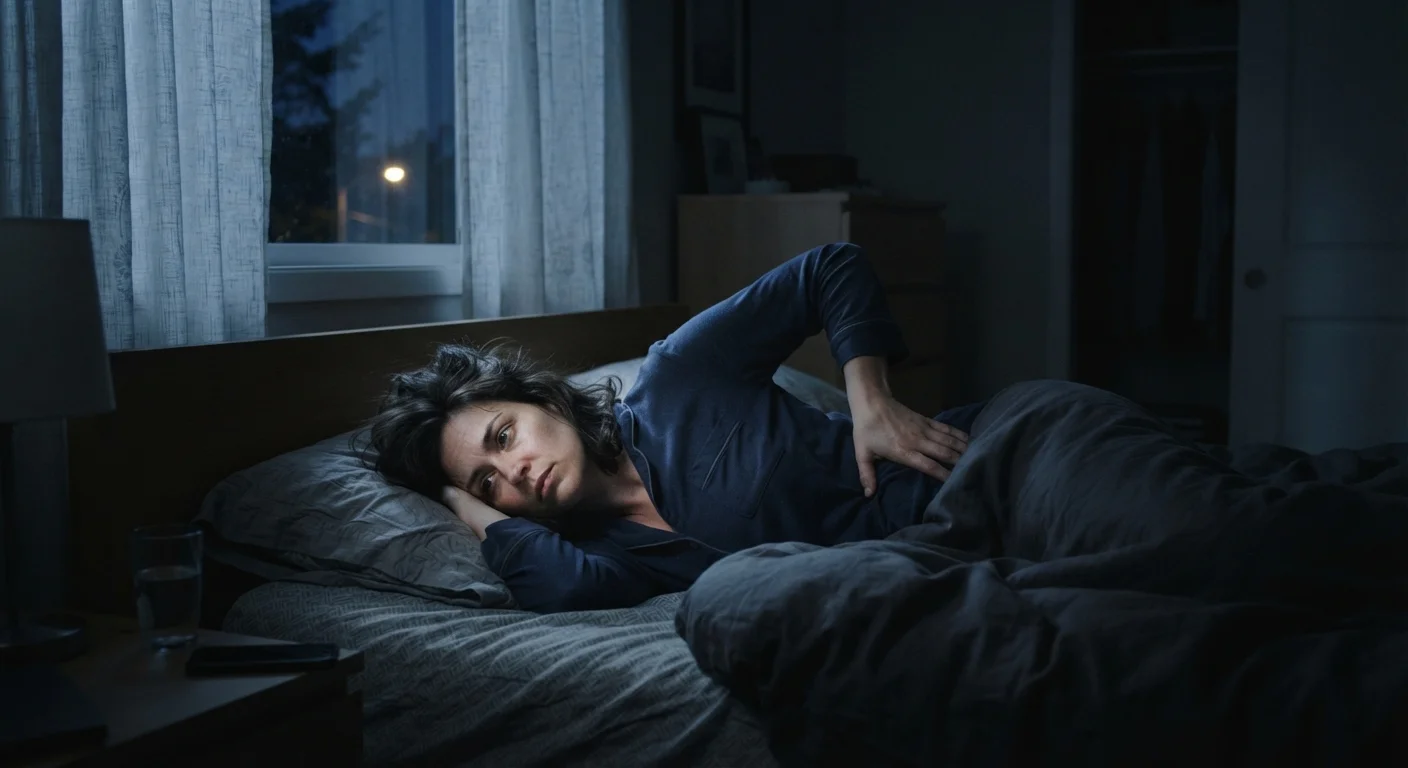
How Pain Disrupts Sleep — The One-Way View That's Incomplete
It is intuitive to think of chronic pain as the cause and poor sleep as the consequence. Pain makes it hard to find a comfortable position, triggers muscle tension, and keeps the nervous system in a low-grade alert state that resists rest. This is accurate — but it is only half the story.
Research in pain medicine has consistently demonstrated that the relationship runs in both directions. Poor sleep does not merely follow from pain; it actively amplifies it. Understanding this bidirectional loop matters because treating only the pain — while ignoring sleep — often produces limited and frustrating results.
Conditions most strongly linked to sleep disruption include fibromyalgia, osteoarthritis, rheumatoid arthritis, and chronic lower back pain. In each of these, patients frequently report not just difficulty falling asleep, but fragmented sleep and reduced time in slow-wave (deep) sleep — the stage most associated with physical restoration. For a broader look at how chronic conditions interact with sleep across age groups, see our article on chronic conditions and sleep in older adults.
50–80%
Chronic pain patients reporting sleep disturbance
Research reviews consistently estimate that between 50% and 80% of people with chronic pain conditions report clinically significant sleep problems, compared with roughly 10–15% of the general population.
~1.5×
Increased pain sensitivity after sleep loss
Laboratory studies, including work published in the Journal of Neuroscience, have found that even partial sleep deprivation measurably lowers pain tolerance, with some participants showing roughly 1.5 times greater pain sensitivity after disrupted sleep.
First-line
CBT-I status for chronic insomnia
The American College of Physicians designates Cognitive Behavioral Therapy for Insomnia (CBT-I) as the first-line treatment for chronic insomnia in adults, including those with comorbid conditions such as chronic pain.
The Biology of the Pain-Sleep Cycle
Sleep serves a critical regulatory role in the central nervous system's ability to modulate pain. During healthy sleep, the brain activates descending inhibitory pathways — essentially, neural circuits that dampen pain signals before they are fully processed. When sleep is insufficient or fragmented, these systems become less effective.
At the same time, sleep deprivation promotes the release of pro-inflammatory cytokines — chemical messengers that increase neuroinflammation and contribute to central sensitization, a state in which the nervous system becomes disproportionately responsive to painful input. This is part of why people report that pain feels markedly worse after a poor night of sleep.
The stress hormone cortisol also plays a role. Disrupted sleep elevates cortisol, which sustains physiological arousal and can heighten pain sensitivity. This connects the sleep-pain cycle to broader stress physiology — a subject explored in depth in our article on how stress physiology disrupts sleep.
“Sleep and pain share overlapping neural circuits. When we deprive the brain of sleep, we are not simply creating fatigue — we are removing one of its most important tools for regulating the pain experience.”
— Matthew Walker, Professor of Neuroscience and Psychology, University of California, Berkeley; author of research on sleep and health
Sleep Hygiene Principles for People Living With Chronic Pain
While sleep hygiene alone will not resolve chronic pain, consistent behavioral practices can reduce the severity of the sleep-pain cycle. The following general principles are drawn from clinical sleep medicine guidelines and are relevant for adults managing persistent pain conditions.
- Maintain a consistent sleep schedule. Going to bed and waking at the same time each day stabilizes circadian rhythms, which regulate both sleep depth and inflammatory signaling.
- Optimize the sleep environment. A cool, dark, quiet room reduces sensory stimulation that can exacerbate pain sensitivity during the hypnagogic (sleep-onset) period.
- Limit time in bed while awake. Stimulus control — a component of CBT-I — involves associating the bed with sleep rather than wakefulness and pain rumination.
- Address pain before attempting sleep. Work with your healthcare provider to discuss whether timing of any prescribed pain management strategies around sleep is appropriate for your situation.
Keep a Sleep and Pain Journal
Tracking both sleep quality and pain levels each day — even briefly — can reveal patterns that are not obvious in the moment. This information is also highly useful when discussing your condition with a healthcare provider. Note sleep duration, nighttime wake-ups, pain intensity on waking, and any notable triggers or changes.
The psychological burden of living with persistent pain — including depression and anxiety — further compounds sleep difficulties. Our companion article on the mental health toll of chronic pain explores these overlapping mechanisms in detail.
Evidence-Based Interventions Worth Discussing With Your Care Team
Beyond general sleep hygiene, several structured approaches have supporting evidence in populations with chronic pain.
Cognitive Behavioral Therapy for Insomnia (CBT-I) is currently considered the first-line treatment for chronic insomnia by major clinical bodies, including the American College of Physicians. Studies in fibromyalgia and osteoarthritis populations suggest CBT-I can improve both sleep continuity and pain-related outcomes. It involves structured sessions targeting sleep-disruptive thoughts and behaviors and does not rely on medication.
Mindfulness-based interventions have also shown promise in chronic pain populations, partly by improving sleep quality and reducing pain catastrophizing — a cognitive pattern that amplifies pain perception.
If you are living with immune dysfunction or a complex chronic pain condition, communicating the full picture of your sleep difficulties to your care team is essential. Our guide on communicating effectively with your care team about chronic pain provides practical strategies for these conversations.
For those curious about how sleep deprivation affects immune function more broadly, the article on sleep and immune function offers a detailed breakdown of the underlying mechanisms.
This article is for general informational and educational purposes only and does not constitute medical advice. If you are experiencing chronic pain or persistent sleep difficulties, please consult a qualified healthcare professional for guidance tailored to your individual circumstances.
Frequently Asked Questions
Chronic pain is a leading contributor to insomnia, making it difficult to fall asleep, stay asleep, or reach restorative sleep stages. Pain signals can fragment sleep architecture throughout the night. However, insomnia can also develop independently and then worsen pain perception, making it a two-directional problem.
Sleep deprivation reduces the effectiveness of the brain's natural pain-suppression systems and promotes neuroinflammation. Studies show that even one or two nights of disrupted sleep can measurably lower pain thresholds in healthy individuals, a finding that is especially significant for those already living with chronic pain.
Evidence suggests that improving sleep quality can reduce pain sensitivity and improve day-to-day pain management, even when the underlying cause of pain persists. Behavioral interventions like CBT-I have shown promise in pain populations. Consult a healthcare provider to explore what approaches are appropriate for your situation.
Cognitive behavioral therapy for insomnia (CBT-I) is a structured, evidence-based psychological treatment for chronic sleep problems. It targets the thoughts and behaviors that perpetuate insomnia. Studies in populations with conditions such as fibromyalgia and osteoarthritis suggest it may improve both sleep quality and pain outcomes.
Short, well-timed naps may help manage fatigue from pain-disrupted nights, but poorly timed or lengthy naps can reduce sleep drive and worsen nighttime insomnia. See our <a href="/healthy-living/sleep-recovery-1/napping-when-it-helps-when-it-hurts-and-how-long-to-keep-it">guidance on napping</a> for what the research suggests.
Yes. Sleep problems and chronic pain frequently co-occur and benefit from integrated management. Many people focus solely on pain control without addressing sleep, which can limit overall progress. Bringing both issues to your care team allows for a more complete treatment picture.
The content on this site is for informational purposes only and is not a substitute for professional advice. Always consult a qualified professional for guidance specific to your situation.