

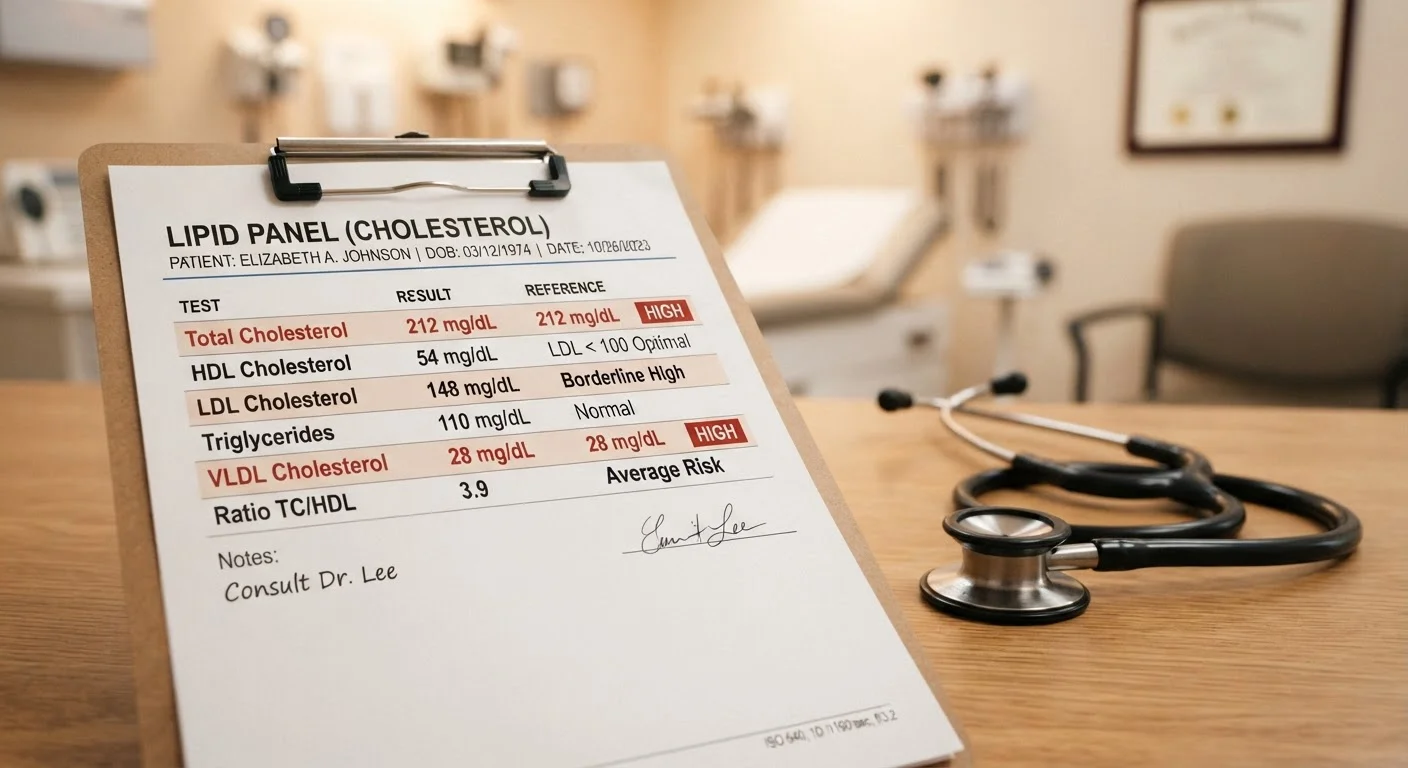
The Limits of the Total Cholesterol Number
When most people think about cholesterol and heart health, they think of a single figure: total cholesterol. But this number is an aggregate — a sum of multiple distinct lipid particles that behave very differently in the body. Treating it as the definitive measure of cardiovascular risk is a bit like judging a city's safety by its total population count alone.
Total cholesterol adds together LDL (low-density lipoprotein), HDL (high-density lipoprotein), and a portion of triglycerides. Because HDL is included in this sum, a person with very high protective HDL could have an elevated total cholesterol that actually reflects a favorable lipid profile. Conversely, someone with borderline total cholesterol may still carry significant risk if their LDL is high and HDL is low.
This is why clinicians rely on a full lipid panel and integrate those results with blood pressure readings, blood glucose levels, smoking status, body weight, and family history. As explored in common heart disease myths, the idea that one cholesterol number tells the whole story is one of the most persistent and misleading beliefs in cardiovascular health.
~50%
Heart attack patients with "normal" LDL at admission
Research published in the American Heart Journal found that nearly half of patients hospitalized for coronary artery disease had LDL levels below 100 mg/dL, highlighting the limits of LDL as a sole risk indicator.
20–30%
Cardiovascular risk reduction linked to LDL lowering
Meta-analyses of statin trials suggest that each 38.6 mg/dL (1 mmol/L) reduction in LDL is associated with approximately a 20–25% relative reduction in major cardiovascular events.
1 in 5
U.S. adults with elevated triglycerides
According to the CDC, roughly one in five U.S. adults has borderline-high or high triglyceride levels, a proportion closely linked to rising rates of obesity and metabolic syndrome.
LDL, HDL, and Triglycerides: What Each Marker Signals
LDL cholesterol is often called "bad" cholesterol because elevated levels are linked to the buildup of fatty plaques inside artery walls — a process called atherosclerosis. However, not all LDL particles carry equal risk. Smaller, denser LDL particles are thought to be more atherogenic than larger ones, which is why some advanced panels look beyond a simple LDL number.
HDL cholesterol is often labeled "good" cholesterol. It helps transport cholesterol away from artery walls back to the liver for processing. Higher HDL levels are generally associated with lower cardiovascular risk, though research has clarified that artificially raising HDL through certain interventions does not always translate to fewer cardiac events — the relationship is complex.
Triglycerides are a form of fat found in the blood. Persistently elevated triglycerides are associated with increased heart disease risk, particularly alongside low HDL or in people with insulin resistance and type 2 diabetes. Dietary habits — especially excess refined carbohydrates, sugar, and alcohol — can significantly influence triglyceride levels.
Non-HDL cholesterol — calculated by subtracting HDL from total cholesterol — captures all potentially harmful cholesterol-carrying particles and is increasingly recognized as a more informative summary marker than LDL alone.
Ask for Your Full Lipid Panel Results
When reviewing blood work with your healthcare provider, ask to see individual values for LDL, HDL, triglycerides, and non-HDL cholesterol — not just the total cholesterol figure. Understanding each component gives you and your clinician a more complete basis for evaluating and managing your cardiovascular risk.
Emerging Markers and the Bigger Clinical Picture
Beyond the standard lipid panel, several additional markers can sharpen cardiovascular risk estimates for selected individuals.
- Apolipoprotein B (ApoB): Measures the total number of atherogenic lipoprotein particles — a metric that some research suggests may outperform LDL cholesterol as a predictor of cardiovascular events.
- Lipoprotein(a) : A genetically influenced lipid particle associated with elevated risk independent of standard lipid values. Testing is particularly relevant for those with a family history of early heart disease.
- High-sensitivity C-reactive protein (hsCRP): A marker of systemic inflammation. Elevated hsCRP can indicate heightened cardiovascular risk even when lipid values appear normal.
These markers are not routinely tested for everyone; clinicians use clinical judgment to determine when additional testing adds meaningful information. Risk is also shaped by factors that no blood test captures — physical activity levels, sleep quality, chronic stress, and socioeconomic circumstances all contribute.
Because cardiovascular risk is dynamic rather than fixed, reassessment matters across the lifespan. Heart health risks shift considerably with age, and a lipid profile that was reassuring at 40 may warrant closer attention by 55.
Risk Calculators Are Starting Points
Tools like the Pooled Cohort Equations estimate 10-year cardiovascular event probability using a combination of clinical variables. They are useful for guiding conversations about prevention but are not definitive predictions for any individual. Your clinician will interpret calculator results alongside your full health picture, including factors these tools may not capture.
This article is for informational purposes only and is not a substitute for professional medical advice, diagnosis, or treatment. Always consult a qualified healthcare provider about your personal cardiovascular risk.
Frequently Asked Questions
Yes. Many people who experience heart attacks have total cholesterol levels within the normal range. This is why clinicians assess the full lipid panel alongside other risk factors such as blood pressure, blood sugar, smoking history, and family history rather than relying on a single number.
Target LDL levels depend on an individual's overall cardiovascular risk profile. Clinical guidelines generally consider lower LDL levels more protective, but specific targets vary by risk category. A healthcare provider can determine an appropriate goal based on your personal health history.
A standard lipid panel measures total cholesterol, LDL (low-density lipoprotein) cholesterol, HDL (high-density lipoprotein) cholesterol, and triglycerides. Some panels also calculate non-HDL cholesterol. Results are interpreted alongside other clinical data, not in isolation.
Elevated triglycerides are associated with increased cardiovascular risk, particularly when combined with low HDL or high LDL. They are especially relevant in the context of metabolic syndrome and type 2 diabetes. Your clinician will consider them alongside other lipid markers.
Lipoprotein(a), or Lp(a), is a type of LDL particle with an additional protein that may make it more prone to contributing to artery-clogging plaques. It is largely genetically determined and is not measured on a standard lipid panel. Testing may be recommended for people with a family history of early heart disease.
The content on this site is for informational purposes only and is not a substitute for professional advice. Always consult a qualified professional for guidance specific to your situation.