

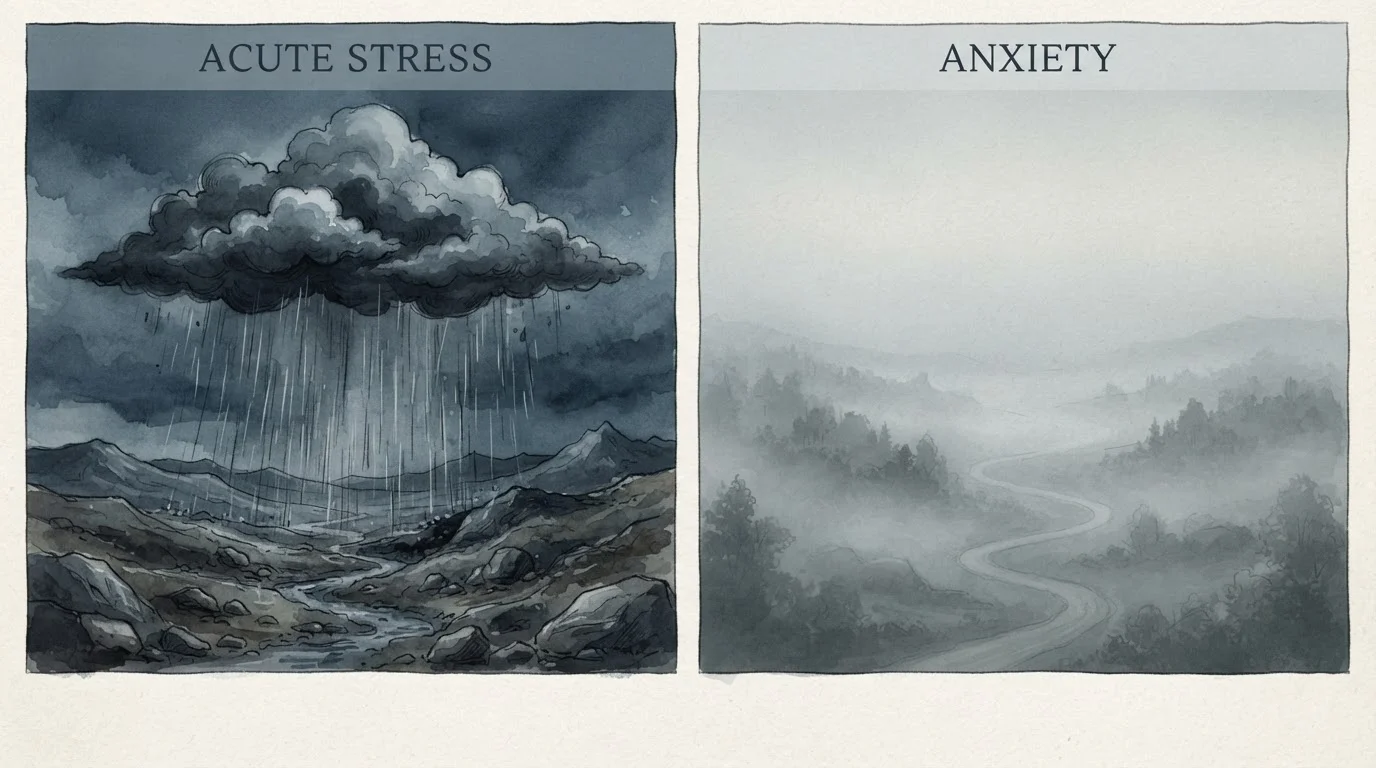
Why the Confusion Makes Sense
If you've ever told someone you're anxious about a work deadline when you meant stressed, you're in good company. The two words are used interchangeably in everyday speech — and the body sensations can feel nearly identical. A tight chest, racing thoughts, poor sleep: these show up in both experiences.
But stress and anxiety are not the same thing, and treating them as identical can leave you reaching for tools that don't quite fit. Understanding the distinction isn't about labeling yourself — it's about knowing yourself well enough to respond effectively.
Both Experiences Are Valid
Distinguishing stress from anxiety is not about ranking which is "worse" or more legitimate. Both are real, both affect health, and both deserve attention. The goal of naming them accurately is simply to help you respond in the way that's most likely to help. If you're unsure which applies to you, a mental health professional can help you sort it out.
What Stress Actually Is
Stress is a response to something outside you. It's the body's alarm system activating in the face of a perceived demand or threat — a looming deadline, a difficult conversation, an unexpected bill. Physiologically, stress triggers the release of cortisol and adrenaline, preparing you to act.
This is sometimes called the fight-or-flight response, and in short bursts it can be genuinely useful. The critical feature of stress is that it has a source you can usually name — and when that source resolves, the stress typically eases with it.
For a deeper look at how stress duration shapes its impact on the body, see our explainer on acute versus chronic stress.
77%
Adults reporting physical stress symptoms
According to the American Psychological Association's Stress in America survey, a large majority of U.S. adults report experiencing physical symptoms they associate with stress.
19.1%
U.S. adults affected by anxiety disorders annually
The Anxiety and Depression Association of America estimates that anxiety disorders affect nearly one in five American adults each year, making them the most common mental health concern in the country.
What Anxiety Actually Is
Anxiety, by contrast, is characterized by worry or fear that persists even when no clear threat is present — or that feels disproportionate to the situation at hand. Where stress says "this problem needs solving," anxiety says "something is wrong" without always being able to point to what.
Anxiety often involves anticipating future threats, ruminating on worst-case scenarios, and struggling to redirect attention even when you want to. It tends to be more self-sustaining than stress: the absence of a stressor doesn't automatically switch it off.
Anxiety exists on a spectrum from everyday nervousness to clinical anxiety disorders. For a comprehensive overview of how different anxiety disorders are defined, our anxiety disorders reference guide is a useful starting point.
How to Tell Them Apart in Your Own Life
A practical question worth asking yourself: "If this situation resolved tomorrow, would the feeling go away?" If yes, what you're experiencing is more likely stress. If you suspect the worry would simply migrate to another concern — or stay without any clear reason — anxiety may be the better description.
A few other distinguishing markers:
- Stress is typically proportional to a real, present demand. It often motivates action.
- Anxiety tends to be future-oriented, difficult to switch off, and can feel untethered from specific facts.
- Stress usually resolves when circumstances change. Anxiety may persist regardless.
Try the 'Remove the Stressor' Test
When you're unsure whether what you're feeling is stress or anxiety, imagine that the current pressure has disappeared entirely. If the relief feels complete and immediate in your imagination, stress is likely the dominant experience. If the worry seems to shift to something else or stays put, anxiety may be playing a larger role — and that's valuable information for choosing your next step.
It's also worth noting that the two often co-occur: prolonged stress can raise baseline anxiety, and anxiety can amplify how stressful ordinary demands feel. Men in particular may find these experiences blend in ways that are worth unpacking — this article on stress, anxiety, and burnout in men explores that intersection.
Responding to Each More Effectively
Once you can name what you're experiencing, you can match your response to it more precisely.
For stress, practical strategies tend to work well: breaking a large task into steps, setting boundaries on workload, addressing the source directly. The goal is reducing or managing the external demand.
For anxiety, the external situation is often not the problem — the nervous system's response is. Approaches that help regulate the anxiety response include diaphragmatic breathing, grounding techniques, and — for persistent anxiety — evidence-based therapies such as CBT. These work by gently challenging unhelpful thought patterns rather than simply removing stressors.
If anxiety feels persistent, uncontrollable, or is affecting your quality of life, that's worth discussing with a healthcare provider. Our guide on when to seek professional help for stress and anxiety outlines the signs that indicate professional support would be beneficial.
This article is for informational and educational purposes only and is not a substitute for professional medical or mental health advice. If you are concerned about your mental health, please consult a qualified healthcare provider.
Frequently Asked Questions
Yes. Chronic, unresolved stress can dysregulate the nervous system in ways that make anxiety more likely to develop. This is one reason managing ongoing stress matters for long-term mental health, not just immediate comfort.
They often overlap — both can cause a racing heart, muscle tension, or disrupted sleep. The key difference is context: stress symptoms tend to ease when the stressor resolves, while anxiety symptoms persist or arise without a clear trigger.
Anxiety exists on a spectrum. Occasional anxiety in response to uncertain situations is a normal human experience. It becomes a clinical concern when it is disproportionate, difficult to control, and significantly disrupts daily life.
If worry or fear feels uncontrollable, lasts most days for several weeks, or is affecting your work, relationships, or sleep, it's worth speaking with a healthcare provider. See our guide on <a href="/mental-wellness/stress-anxiety/when-to-seek-professional-help-for-stress-and-anxiety">recognizing when to seek professional support</a>.
Somewhat. Problem-solving and time management work well for stress tied to concrete situations. Anxiety often responds better to approaches that address thought patterns — such as cognitive behavioral techniques — alongside relaxation practices. A mental health professional can help tailor strategies to your specific experience.
The content on this site is for informational purposes only and is not a substitute for professional advice. Always consult a qualified professional for guidance specific to your situation.