

Our Verdict
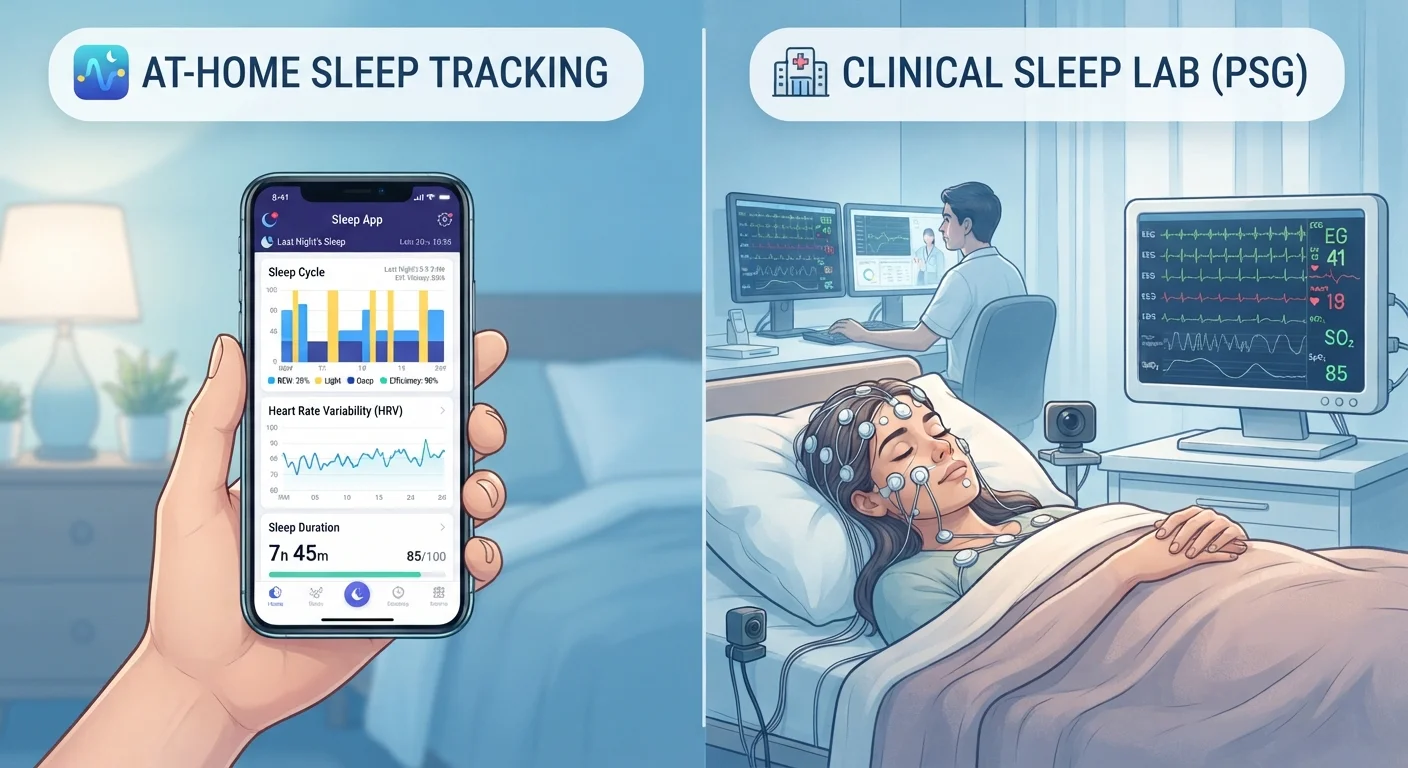
Sleep tracking apps and clinical sleep studies are complementary tools, not competitors. Apps offer accessible, longitudinal insight into sleep behaviors and can prompt helpful conversations with a clinician. Clinical polysomnography provides the diagnostic depth needed to identify and treat genuine sleep disorders. Choosing the right tool depends entirely on your goal.
| Best for | Recommended |
|---|---|
| Building and monitoring general sleep hygiene habits | Sleep Tracking App |
| Diagnosing a suspected sleep disorder such as sleep apnea or narcolepsy | Clinical Sleep Study (Polysomnography) |
| Identifying broad behavioral patterns to discuss with a doctor | Sleep Tracking App |
| Older adults managing chronic conditions affecting sleep quality | Clinical Sleep Study (Polysomnography) |
Two Very Different Windows Into Your Sleep
If you've ever woken up feeling exhausted while your phone cheerfully reports eight hours of "deep sleep," you've already sensed the gap between what consumer apps measure and what's actually happening in your brain. That gap matters — not because sleep trackers are worthless, but because they answer fundamentally different questions than a clinical evaluation does.
Understanding what each tool can and cannot tell you is the first step toward using both wisely. This is especially important given the strong link between restorative sleep and mental wellness. For a broader look at how sleep quality affects long-term health, see the comprehensive guide to sleep and recovery.
How Sleep Tracking Apps Work — and Where They Fall Short
Consumer wearables and smartphone apps typically rely on actigraphy — detecting movement via accelerometer — combined with heart rate variability data to infer sleep stages. Algorithms then translate these signals into familiar labels: light sleep, deep sleep, REM sleep.
The problem is that sleep stage classification in clinical medicine depends on electroencephalography (EEG), which measures brain wave activity directly. No wrist-worn device currently does this. Multiple validation studies have found that consumer trackers perform reasonably well at distinguishing sleep from wakefulness, but are substantially less reliable when distinguishing specific sleep stages, particularly slow-wave (deep) sleep and REM.
| Sleep Tracking App | Clinical Sleep Study (PSG) | |
|---|---|---|
| Primary technology | Accelerometer + heart rate (actigraphy) | EEG, EMG, EOG, ECG, respiratory sensors |
| Sleep stage accuracy | Moderate (wake vs. sleep reliable; stage detail limited) | High (validated clinical standard) |
| Can diagnose sleep disorders | No | Yes |
| Setting | Home, continuous nightly use | Lab or home (one or a few nights) |
| Cost and access | Low cost, widely available | Higher cost, requires physician referral |
| Best use case | Behavioral pattern awareness | Medical diagnosis and disorder management |
Beyond accuracy, there is a documented psychological risk worth naming: orthosomnia — a term researchers have used to describe anxiety and sleep disruption caused by preoccupation with achieving "perfect" sleep tracker scores. If your app data is becoming a source of stress rather than useful information, that concern is worth raising with a clinician. You can also explore common sleep myths that may be undermining your rest to put your data in perspective.
What Clinical Sleep Studies Actually Measure
Polysomnography (PSG) — the clinical gold standard — records brain waves (EEG), eye movements (EOG), muscle activity (EMG), heart rhythm (ECG), respiratory effort, blood oxygen saturation, and airflow simultaneously throughout the night. A trained sleep technologist monitors the session in real time, and a board-certified sleep medicine physician interprets the results.
This level of physiological detail allows clinicians to accurately identify conditions such as obstructive sleep apnea, central sleep apnea, periodic limb movement disorder, narcolepsy, and REM sleep behavior disorder — none of which a consumer app can reliably detect. For people managing chronic illnesses, the stakes of an accurate diagnosis are particularly high. Our article on chronic conditions and sleep in older adults explores this two-way relationship in depth.
Bring Your App Data to Your Appointment
If you've been tracking sleep with an app, exporting a few weeks of trend data before a clinical appointment can help your doctor identify patterns worth investigating further. Describe any symptoms you experience — daytime fatigue, mood changes, morning headaches — alongside the data. App scores alone are not diagnostic, but they can help focus the clinical conversation.
A clinical study is typically ordered by a physician when symptoms such as loud snoring, witnessed breathing pauses, excessive daytime sleepiness, or unexplained mood changes are present. It is not a routine screening tool for the general population.
Using Each Tool Appropriately
Sleep tracking apps are most valuable as behavioral mirrors. Over weeks or months, consistent data can surface patterns — late bedtimes, alcohol's effect on sleep efficiency, the impact of exercise timing — that support better sleep hygiene decisions. Mental health professionals who discuss sleep often find that patient-generated data from apps can be a useful starting point for clinical conversations. See what sleep habits mental health professionals commonly recommend to understand how behavioral strategies complement clinical care.
Clinical sleep studies, on the other hand, are diagnostic instruments. They belong in the picture when you or your doctor suspects an underlying disorder — not as a response to a low "sleep score" on an app. If you share app data with your physician, frame it as context, not diagnosis.
~80%
App accuracy for sleep vs. wake detection
Research published in sleep medicine journals suggests consumer trackers are roughly 80% accurate at distinguishing sleep from wakefulness, but considerably less precise for individual sleep stages.
~1 billion
Wearable sleep tracker users globally
Industry analyses estimate that hundreds of millions of wearable devices with sleep tracking features are in use worldwide, reflecting the scale of consumer interest in sleep data.
This article is for informational purposes only and does not constitute medical advice. If you have concerns about your sleep or suspect a sleep disorder, please consult a qualified healthcare provider.
The content on this site is for informational purposes only and is not a substitute for professional advice. Always consult a qualified professional for guidance specific to your situation.