

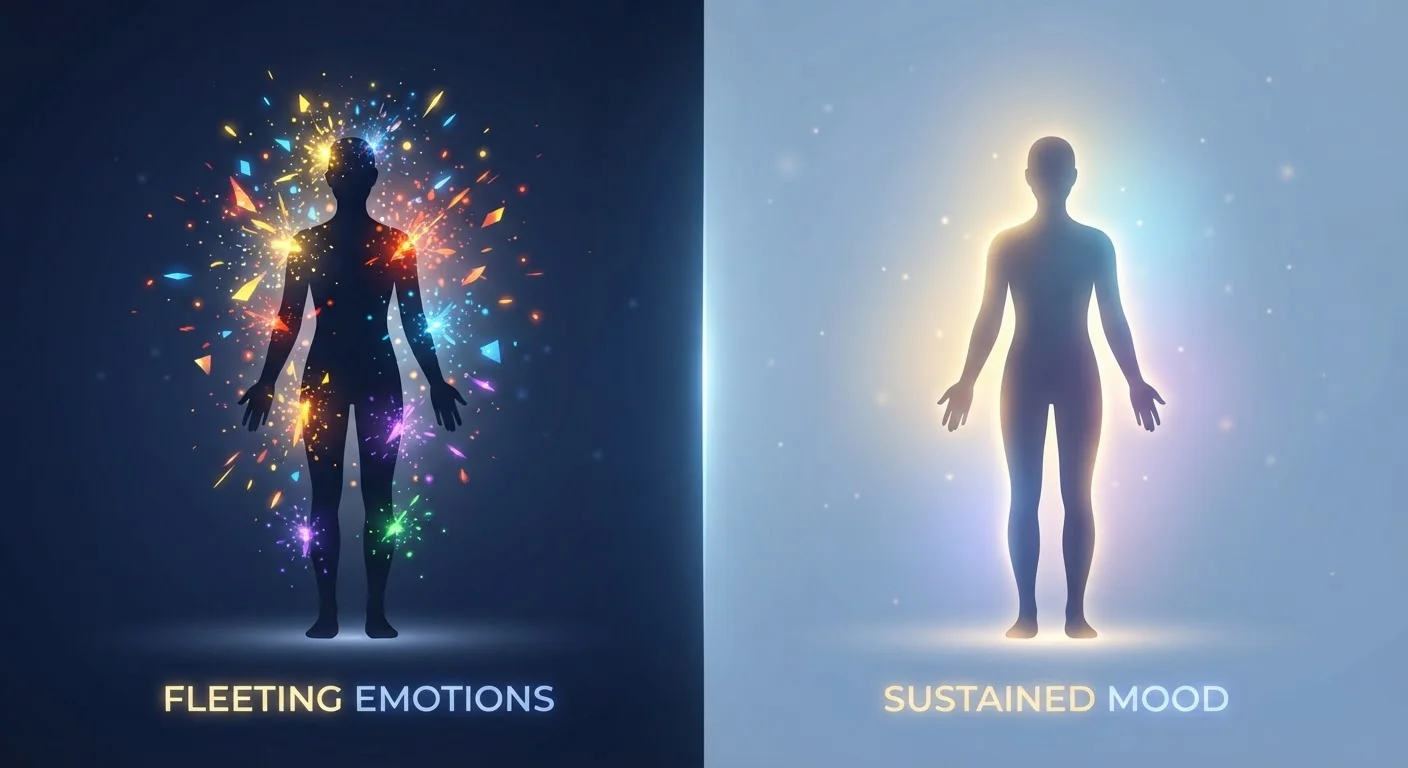
Option A
Emotion
The intense, short-lived signal tied to a specific trigger.
Best for: Alerting you to something meaningful in your environment and prompting an immediate response.
Option B
Mood
The diffuse, longer-lasting backdrop coloring your experience.
Best for: Reflecting underlying patterns in sleep, stress, hormones, or lifestyle that deserve attention over time.
Two Different Animals: Defining Emotion and Mood
Most of us use the words emotion and mood interchangeably in everyday conversation — but psychologists and neuroscientists draw a meaningful distinction between them. Getting that distinction right isn't just academic; it can genuinely change how you relate to your own inner life.
Emotions are typically defined as short-lived, high-intensity states that arise in response to a specific stimulus. Seeing a spider triggers fear. Receiving unexpected praise sparks joy. Emotions usually last seconds to minutes, are tied to an identifiable cause, and involve noticeable physical changes — a quickened pulse, a wave of warmth, a tightening chest.
Moods, by contrast, are lower-intensity states that persist for hours, days, or even longer, often without a clear trigger. You wake up feeling vaguely irritable or inexplicably upbeat without knowing exactly why. Moods form a kind of emotional backdrop that quietly colors how you interpret events, interact with others, and make decisions.
Research in affective science generally characterizes emotions as object-directed (they're about something specific) and moods as objectless (they're global and diffuse). This is a subtle but important line. If you're angry at a colleague, that's an emotion. If you're just generally on edge all afternoon, that's a mood.
Understanding this framework is a useful first step toward the kind of self-awareness explored in our guide to what a healthy emotional range looks like.
| Criterion | Emotion | Mood |
|---|---|---|
| Duration | Seconds to minutes | Hours to days |
| Intensity | High, often acute | Lower, more diffuse |
| Cause | Specific, identifiable trigger | Often no clear trigger |
| Physical changes | Pronounced (racing heart, flush) | Subtle, background-level |
| Key brain systems | Amygdala, fast neural circuits | Neurochemical systems (serotonin, cortisol) |
| Effect on thinking | Immediate focus shift | Broad interpretive filter |
| Awareness | Usually easy to label | Often vague or hard to name |
How Each One Works in the Brain and Body
Emotions engage fast-acting neural circuits. The amygdala — a region deep in the brain involved in threat detection and reward — plays a central role in generating emotional responses. This is why emotions can feel almost instantaneous: they're partly designed to mobilize you before your conscious mind fully catches up.
Moods, on the other hand, are more closely linked to slower-acting neurochemical systems. Neurotransmitters like serotonin and dopamine, as well as hormones such as cortisol and estrogen, contribute significantly to your baseline mood state. This is partly why disrupted sleep, chronic stress, hormonal shifts, or physical illness can alter mood without producing any single emotional trigger — and why everyday habits quietly shape how you feel over time.
~90 sec
Typical lifespan of a single emotion
Neuroscientist Jill Bolte Taylor's widely cited research suggests the physiological surge of a single emotion typically peaks and dissipates within about 90 seconds.
~60%
Adults who report difficulty naming their feelings
Studies on emotional granularity suggest a substantial portion of adults struggle to distinguish between different emotional states, affecting how they manage stress.
Because moods are slower and more diffuse, they're also harder to simply "shake off." They tend to act as interpretive filters: when you're in a low mood, neutral events can appear threatening; in a positive mood, minor setbacks feel more manageable. This filtering effect is well-documented in cognitive psychology and has real implications for decision-making quality.
Why the Distinction Matters for Your Wellbeing
Conflating moods and emotions can lead to unhelpful patterns. For example, if you mistake a low mood for a specific feeling of sadness about something, you may spend time searching for a cause that doesn't really exist — or blame a relationship, job, or circumstance that isn't actually the source.
Conversely, if you dismiss a genuine emotion as "just being in a mood," you may miss a signal that something in your environment or relationships needs attention. Misreading your own emotions is more common than most people realize, and learning to distinguish categories is one practical way to sharpen that skill.
When to Seek Professional Support
While both emotions and moods are part of normal human experience, a mood that persists for two or more weeks — especially one involving hopelessness, inability to function, or thoughts of self-harm — warrants professional attention. This is general information, not a diagnostic threshold; please speak with a qualified mental health professional if you have concerns about your emotional health.
It's also worth noting that sustained changes in mood — especially when they last two weeks or more and affect daily functioning — can be a clinical signal worth discussing with a healthcare professional. This applies especially during periods of hormonal change; for example, mood shifts during perimenopause range from expected to worth professional evaluation.
Tracking your moods over time — even with a simple journal or app — can reveal patterns tied to sleep, nutrition, movement, or stress that you might not otherwise notice. Emotions, meanwhile, are best worked with in the moment: naming them, acknowledging their physical signatures, and considering what they might be signaling.
This article is for informational purposes only and is not a substitute for professional medical or mental health advice. If you're concerned about persistent mood changes or emotional difficulties, please consult a qualified healthcare provider.
The content on this site is for informational purposes only and is not a substitute for professional advice. Always consult a qualified professional for guidance specific to your situation.