

The Three-Part Chain Reaction
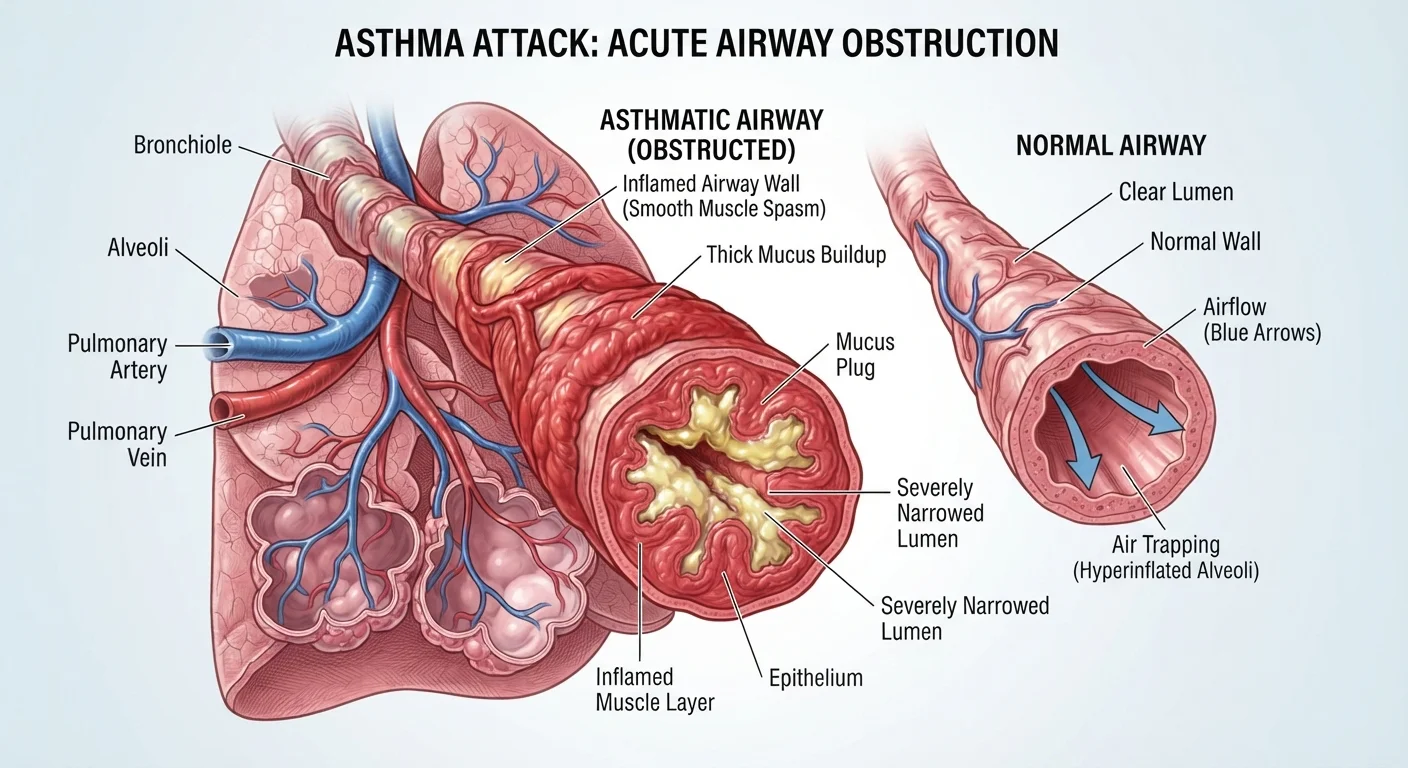
When an asthma attack begins, three distinct but interconnected changes occur in the airways almost simultaneously. Understanding each one explains why breathing becomes so difficult so quickly.
Bronchoconstriction is usually the first event. The smooth muscle wrapped around each bronchial tube—the branching passages that carry air deep into the lungs—suddenly contracts. This squeezes the airway from the outside, reducing its diameter. Even a small reduction has an outsized effect: because airway resistance increases to the fourth power of the reduction in radius, a 50% narrowing increases resistance roughly 16-fold.
Airway inflammation and swelling follow closely. The airway lining (mucosa) becomes engorged with fluid as immune cells flood the area and release inflammatory chemicals. This swelling further tightens the already-constricted passage from the inside.
Mucus hypersecretion compounds both problems. Goblet cells in the airway lining overproduce thick, sticky mucus that can partially or fully plug smaller airways. This is why persistent coughing is such a hallmark symptom—the body is trying to clear passages that are chemically designed, in this moment, to stay obstructed.
Asthma Attacks Are Not Uniform
Asthma attacks vary widely in severity and duration. A mild episode may resolve within minutes with a rescue inhaler, while a severe exacerbation may require emergency medical treatment. The absence of loud wheezing does not indicate a mild attack—in very severe cases, so little air is moving that no wheeze is audible at all. Always follow your personalized asthma action plan and consult your healthcare provider about what constitutes an emergency for you.
Why Exhaling Becomes the Hardest Part
Most people assume that inhaling is the primary struggle during an asthma attack. In reality, exhalation is often more difficult. Here's why.
During a normal breath out, the lungs naturally recoil and the chest wall relaxes, gently pushing air upward and out. In healthy airways, this passive process works fine. But in already-narrowed asthmatic airways, the outward pressure of exhalation causes the weakened, inflamed walls to collapse slightly inward—further reducing airflow.
The result is air trapping: stale air accumulates in the lower lungs because it cannot be fully expelled. This is why asthma patients often describe a persistent sense of chest fullness or tightness. Over the course of a prolonged attack, the lungs become increasingly over-inflated, which also forces the diaphragm and breathing muscles to work much harder than usual just to draw the next breath.
The characteristic wheeze of asthma is the audible sound of air being forced through these critically narrowed passages—particularly on exhalation.
Know Your Early Warning Signs
Many people with asthma experience personal prodromal signals—subtle changes that precede a full attack. These might include more frequent nighttime coughing, mild throat tightness, or fatigue after light activity. Working with your healthcare provider to identify and document your specific early signals can give you a critical window to intervene before symptoms escalate.
The Immune System's Role
Asthma is fundamentally an inflammatory disease, and an acute attack is the peak expression of an ongoing immune process. In most people with asthma, the airways are in a state of chronic low-level inflammation even between attacks—a smoldering readiness to react.
When a trigger is encountered—whether it is pollen, pet dander, cold air, smoke, or exercise—mast cells and other immune cells already present in the airway lining release a surge of chemicals: histamine, leukotrienes, prostaglandins, and cytokines. These substances are the actual architects of bronchoconstriction, swelling, and mucus production.
This is why exposure to indoor air pollutants can be particularly problematic for people with asthma. For a deeper look at how indoor environments affect breathing, see what the research suggests about indoor air quality and lung health.
25 million
Americans currently living with asthma
According to the U.S. Centers for Disease Control and Prevention (CDC), approximately 25 million people in the United States have asthma.
~1.6 million
Annual U.S. emergency department visits for asthma
The CDC reports roughly 1.6 million emergency department visits related to asthma occur in the United States each year.
4x
Airway resistance increase from modest narrowing
Airway resistance is governed by Poiseuille's law; even a modest reduction in airway radius significantly multiplies the resistance air must overcome with each breath.
Recognizing Early Warning Signs and Taking Action
The inflammatory cascade that leads to a full asthma attack rarely appears without warning. Early signs—sometimes called prodromal symptoms—can include increased nighttime coughing, mild chest tightness upon waking, or a subtle drop in peak flow meter readings. Recognizing these signals early is one of the most powerful tools for preventing a severe episode.
Because triggers vary significantly from person to person, structured tracking over time is essential. Learning to track your personal asthma triggers gives you actionable data to share with your healthcare provider and adjust your daily management plan accordingly.
For families, it is worth noting that asthma in children can present differently. Parents and caregivers should understand the signs of asthma in children that adults might miss, since children may not articulate breathing difficulty in the same way adults do.
This article is for general informational purposes only and is not a substitute for professional medical advice, diagnosis, or treatment. If you or someone you know is experiencing breathing difficulty, contact a qualified healthcare provider or call emergency services immediately.
Frequently Asked Questions
During an asthma attack, narrowed airways collapse slightly under the pressure of exhalation, trapping air inside the lungs. This is why people with asthma often wheeze and feel a persistent sense of fullness in the chest, even after inhaling.
The smooth muscle surrounding the airways contracts in response to triggers—such as allergens, cold air, exercise, or irritants—activating immune cells that release inflammatory chemicals. These chemicals, including histamine and leukotrienes, cause the muscles to squeeze and the airway lining to swell.
Severe attacks can escalate within minutes, particularly when oxygen levels drop or the breathing muscles fatigue. Anyone experiencing a sudden, severe attack that does not respond to a rescue inhaler should seek emergency medical care immediately.
Yes. In some severe attacks, airflow is so restricted that no wheeze is audible—a situation sometimes called a "silent chest." This is a medical emergency. Absence of wheeze does not mean an attack is mild.
Repeated, poorly controlled asthma attacks can lead to airway remodeling—structural changes that may permanently reduce lung function over time. Consistent management under medical supervision is the most effective way to protect long-term lung health.
The content on this site is for informational purposes only and is not a substitute for professional advice. Always consult a qualified professional for guidance specific to your situation.