

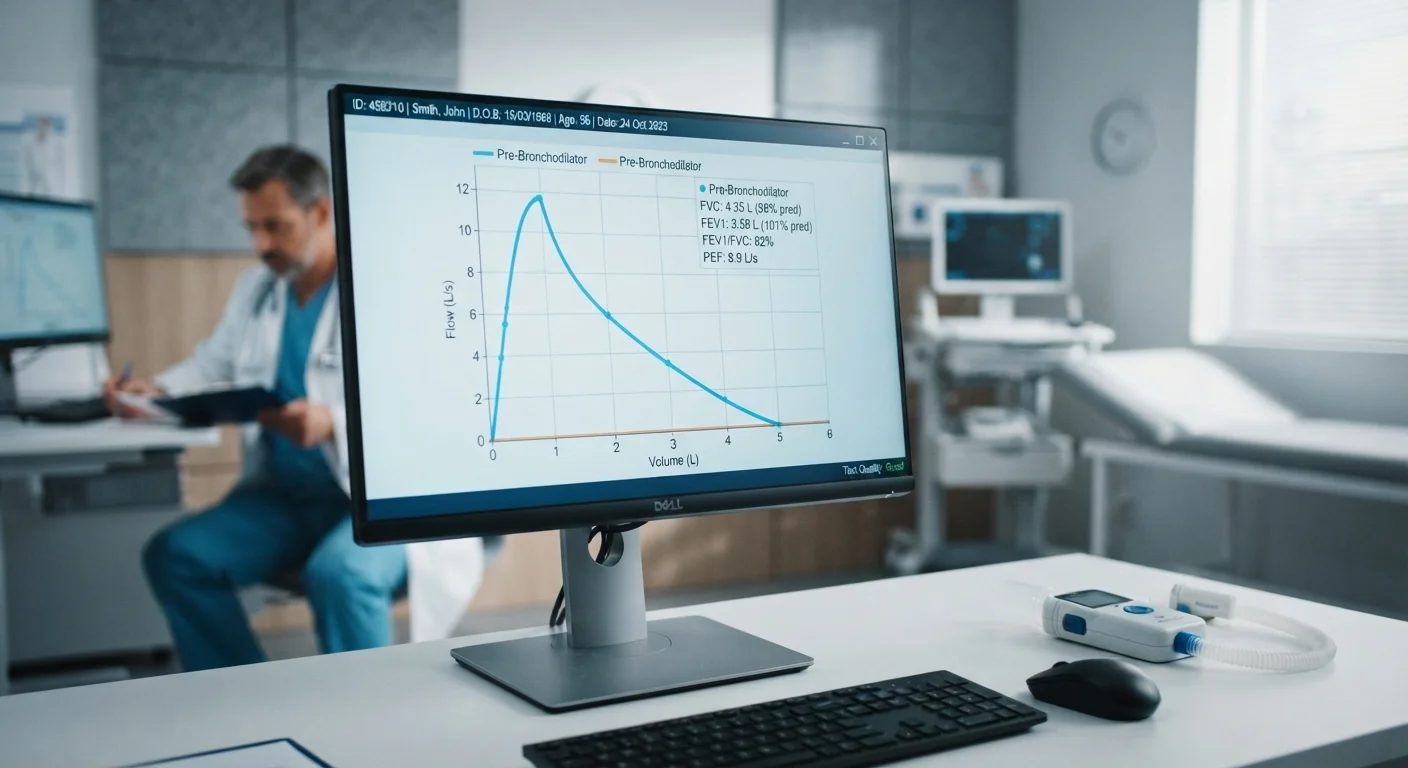
What Spirometry Measures — and Why It Matters
Spirometry is the most commonly performed lung function test. It measures how much air you can breathe in and out, and how quickly you can do it. Clinicians use the results to detect, classify, and monitor conditions such as asthma, chronic obstructive pulmonary disease (COPD), and pulmonary fibrosis.
During the test, you breathe forcefully into a device called a spirometer. The machine records your effort as a series of numerical values and curves. Understanding what those values represent helps you have more informed conversations with your healthcare provider.
If you have recently received a respiratory diagnosis and need broader context, the Respiratory Conditions Explained starter guide covers the landscape of common diagnoses in plain language.
| Test type | Lung function (pulmonary function) test |
| Primary values reported | FEV1, FVC, FEV1/FVC ratio |
| Normal FEV1/FVC ratio | ≥0.70 (70%) in most adults (GOLD Guidelines, ATS/ERS Standards) |
| Normal range (% predicted) | ≥80% for FEV1 and FVC (ATS/ERS Spirometry Standards) |
| Conditions commonly diagnosed | Asthma, COPD, pulmonary fibrosis |
| Bronchodilator reversibility threshold | ≥12% and ≥200 mL increase (ATS/ERS Task Force Guidelines) |
The Core Values: FEV1, FVC, and the FEV1/FVC Ratio
Three numbers anchor almost every spirometry report:
- FVC (Forced Vital Capacity): The total volume of air you can exhale after taking the deepest breath possible. It reflects overall lung capacity.
- FEV1 (Forced Expiratory Volume in 1 second): How much of that air you can push out in the first second. It is the single most important marker of airflow obstruction.
- FEV1/FVC ratio: FEV1 expressed as a proportion of FVC. Healthy lungs typically produce a ratio above 0.70 (70%). A ratio below this threshold suggests airflow obstruction.
Results are also expressed as a percentage of predicted — your value compared to what is expected for a person of your age, sex, height, and ethnicity. A value of 80% predicted or above is generally considered within the normal range, though laboratories may apply slightly different reference equations.
80%
Minimum % predicted for normal FEV1
According to American Thoracic Society and European Respiratory Society spirometry standards.
0.70
FEV1/FVC ratio threshold for obstruction
A fixed ratio below 0.70 is the GOLD criterion for diagnosing airflow obstruction consistent with COPD.
3
Acceptable maneuvers required per test
ATS/ERS quality standards require at least three technically acceptable efforts to ensure reliable results.
Interpreting Patterns: Obstructive vs. Restrictive
Spirometry identifies two broad abnormality patterns:
- Obstructive pattern
- A low FEV1/FVC ratio with a relatively preserved FVC. Air gets trapped or flows slowly out of narrowed airways. Asthma and COPD are the most common causes. COPD severity is graded using FEV1 % predicted: mild (≥80%), moderate (50–79%), severe (30–49%), and very severe (<30%), as defined by GOLD (Global Initiative for Chronic Obstructive Lung Disease) criteria.
- Restrictive pattern
- FVC is reduced but the FEV1/FVC ratio is normal or elevated, meaning the lungs are smaller than expected but airways are not narrowed. Pulmonary fibrosis, obesity, and neuromuscular disease can produce this pattern. Note that spirometry alone cannot confirm restriction — a full set of lung volumes is needed.
Some patients show a mixed pattern, where both the ratio and FVC are reduced. This requires further testing to interpret accurately.
FVC (Forced Vital Capacity)
The total volume of air forcefully exhaled after a maximum inhalation. It reflects the overall capacity of the lungs to hold and expel air.
FEV1
The volume of air exhaled in the first second of a forced breath. It is the primary marker of airway obstruction and is used to grade COPD severity.
FEV1/FVC Ratio
FEV1 expressed as a fraction of FVC. A ratio below 0.70 indicates that airflow out of the lungs is obstructed.
% Predicted
Your measured value expressed as a percentage of the expected value for a person with your age, sex, height, and ethnicity. It contextualizes raw numbers against a reference population.
Bronchodilator Reversibility
A significant improvement in FEV1 or FVC after inhaling a bronchodilator, suggesting the airway narrowing is at least partly reversible — a hallmark feature of asthma.
Obstructive Pattern
A spirometry finding where the FEV1/FVC ratio is below normal, indicating narrowed or blocked airways that slow airflow out of the lungs.
Restrictive Pattern
A spirometry finding where FVC is reduced but the FEV1/FVC ratio is preserved, suggesting the lungs are smaller or stiffer than normal rather than obstructed.
Bronchodilator Reversibility and What It Adds
Many spirometry tests include a bronchodilator response phase. You receive an inhaled bronchodilator medication, then repeat the maneuver after 10–15 minutes. An increase in FEV1 or FVC of ≥12% and ≥200 mL is considered a significant positive response, which supports a diagnosis of asthma over COPD — though clinical context always matters.
A negative bronchodilator response does not rule out asthma; some patients show variability at other times or with other triggers.
Spirometry Quality Depends on Patient Effort
Spirometry is an effort-dependent test — results are only valid when the patient gives a maximal, consistent effort. Technicians are trained to coach patients and flag suboptimal attempts. If your report notes poor quality or fewer than three acceptable maneuvers, your provider may recommend repeating the test before drawing conclusions.
This article is for general informational purposes only and does not constitute medical advice. Always consult a qualified healthcare professional to interpret your specific test results and guide any treatment decisions.
The content on this site is for informational purposes only and is not a substitute for professional advice. Always consult a qualified professional for guidance specific to your situation.